Knowledge


B2B sales process: stages, framework and an implementation example
The B2B sales process: how to build it so that the company grows predictably
What really separates a company standing still from one that can grow and outpace the competition is not luck, chance or a great product. The biggest difference is made by sales. But sales that are organized, repeatable and scalable.
Sure, the market, the quality of solutions, the competitive environment or customer service matter. Let us assume, however, that you have solid foundations: you work in an industry with high-margin potential, and demand for your solutions exists.
In such a situation, most often only one thing blocks further growth: the lack of an organized, predictable sales process that can be scaled. The rest of the article will show where this certainty comes from, what hard data say about the process, and how to approach the topic so as not to end up with another document nobody reads.
What a B2B sales process is
A sales process is a designed sequence of activities that leads the client from first contact to purchase in a repeatable, measurable and scalable way.
There is no single universal sales process that will work in every company. Each organization operates in a slightly different context: it has its own USP, reaches specific customer segments and builds relationships based on completely different expectations. On top of that come the specifics of the industry, differences in the offer and the way the client has to be guided. That is why effective sales must always be adapted to the company, the market and the clients we want to win. Sales consulting helps improve the process when it already exists, or build it when it has not yet been defined.
Before we go further, however, one misunderstanding that appears in almost every conversation about sales needs clearing up.
“We have a sales process” is one of those sentences that comes up exceptionally often. Usually said with conviction, sometimes even with pride. But when I start asking what specifically this process covers, the conversation very quickly turns to the CRM, the stages in the funnel or the salesperson’s task list.
A sales process is not a CRM. Nor is it a list of steps to tick off or a set of slides from a training. A CRM is the tool in which you record the process. The sales funnel shows where clients are at a given moment. Both are important, but neither of them says what has to happen for the client to move on. A company that only has a CRM knows how many opportunities it has in the funnel. A company that has a process knows what to do to move those opportunities forward. This difference is practical, not academic, and it is visible to the naked eye in the results.
Check whether you really have a sales process
There is one question that quickly verifies this: why did this client buy, and that one not?
If the answers are “because he was determined”, “because he had the budget”, “because he liked it”, those are not elements of a process. They are observations after the fact. Companies that really have a process can point to the specific stage at which the conversation went in the right or wrong direction. They know which steps matter. They know where blockage most often occurs and what objections appear regularly. And most importantly, they can improve this process, because they have something to refer to.
Without this, sales turn into improvisation. It may work as long as the scale is small and everything goes through the owner. When the company starts to grow, everyone does it their own way. One sends the offer right away. Another after a week. A third calls five times. A fourth only emails. Then comes the frustration that results jump from month to month, and building a sales process is put off until the next “less intense time”.
Data from the TechMine study among B2B business owners and C-level people show this clearly. 91% of respondents considered needs discovery important or very important. At the same time 55% admitted that they sometimes present an offer without discovering needs, and 66% do so even when they know the solution does not fit the client’s situation. But the most important number is a different one: where needs discovery was not a formal requirement of the process, it was skipped in one hundred percent of cases. Only 32% of companies have a fully standardized process. This is not a gap in awareness, but in the architecture of sales.
One question gives a first signal, but it is still an impression, not a measurement. If you want to see what it looks like for you in numbers, take the diagnosis below. You answer 33 questions about how sales really work in your company, and at the end you get a maturity index from 0 to 100 broken down into five pillars. Process is one of them, so you can immediately see whether it is what drags the result down, or whether the trouble lies elsewhere, for example in strategy or measurement. The overall result appears on screen without giving an email address.
Sales maturity diagnosis (in Polish) · 33 questions · about 11 minutes · result right on screen
What the research says: the sales process and company results
Intuition suggests that an organized process should help. The data make it possible to determine by how much.
A study published by Harvard Business Review showed that companies that invested time in defining a credible, formalized sales process achieved 18% higher revenue growth than companies that did not. Another HBR study indicated that organizations with a standardized sales process record up to 28% higher revenue compared to companies operating ad hoc.
The scale of the difference is impressive, but even more interesting is what happens at the level of individual teams. Half of the best-performing sales organizations have a “closely monitored, strictly enforced or automated” sales process, according to HBR. At the other end of the spectrum, 48% of poorly performing organizations admit to having no formalized process. The Sales Management Association, in turn, reports that 90% of companies using a formal, structured sales process are among the best-performing organizations.
The impact of the process goes beyond revenue alone. According to the TAS Group and their Dealmaker Index Study, over 70% of companies with a well-defined process achieve high accuracy of sales forecasts. For those running a company this is a huge difference, because it means predictability of cash flows, better resource planning and lower operational risk.
The perspective of the cost of not having a process also deserves attention. A 2024 report by Ebsta and Pavilion showed that 69% of salespeople did not hit their targets. Salesforce research indicates that sales representatives spend only 28% of their working time on actual sales activities; the rest is taken up by administrative tasks, meetings and work unrelated to generating revenue. These numbers look different in companies with a well-designed process, because it is known what specifically a salesperson’s time should go to and what they should concentrate on at a given stage.
Research by Salesmotion from 2026 adds one more dimension: 63% of lost sales opportunities drop out of the funnel before the needs discovery stage. Improving the quality of discovery and tightening qualification criteria have a greater impact on win rate than negotiation training or optimizing the sales offer. This clearly indicates where the greatest leverage in the sales process is.
Stages of the B2B sales process
Although there is no single universal process, the component elements tend to be repeatable. A typical B2B outbound sales process may include the following sequence: building contact databases (lead sourcing), making contact (phone, email, LinkedIn), lead qualification (rejecting clients we do not want to serve), in-depth needs discovery, solution presentation (demo or offer), negotiations and handling objections, closing the sale, and then cross-sell and upsell.
Of course the list above is not complete. Sales processes rarely look so linear and transparent. They are usually accompanied by numerous follow-ups, adapting the solution to the client’s context and formal matters related to the contract.
But there is something that distinguishes well-designed processes from those sketched “quickly” in some tool. In a good process, at every stage a specific goal is set that does not sound like “sell”. In episode 22 of the podcast Droga Przedsiebiorcy I discussed the Value Triangle, the central element of the sales system SalesMachine, and that is exactly the topic I address there: the goal of the individual stages of the process is to move the client to the next step, and closing the sale is a side effect of a well-conducted process.
Take a simple example. At the prospecting stage the goal is not “to present the offer”. The goal is to make the client themselves become interested in how your company deals with the problem that affects them and want to talk further. In episode 23 of Droga Przedsiebiorcy I explain exactly how to build such communication in cold mailing and what results it brings. I quote there a reply from the CEO of a company who wrote that he did not reflexively delete the email, because he saw a short subject in lower case that gave the impression of a message from a client or a friend, and the content was neat enough that he read to the end. This effect does not appear by accident. It is the result of a well-thought-out prospecting process in which the preparation of the database, research, the communication concept and the text of the message itself form a coherent sequence.
At the needs discovery stage, in turn, the goal is not “to gather information for the offer”, but to diagnose the client’s real situation, so that the client feels you really understand them. At the solution presentation (demo) stage, the goal is to demonstrate the value proposition in the context of what you heard during discovery, not to discuss the features, advantages and benefits of the solution. In episode 4 of the podcast Droga Przedsiebiorcy I discuss how such a demo should be built in a B2B service company and why the price is worth giving only at the very end of the presentation, when the value has already been proven and the client has confirmed that they need what you are talking about.
These nuances in the approach to goals at individual stages are the difference between a process that works and a list of steps in a CRM.
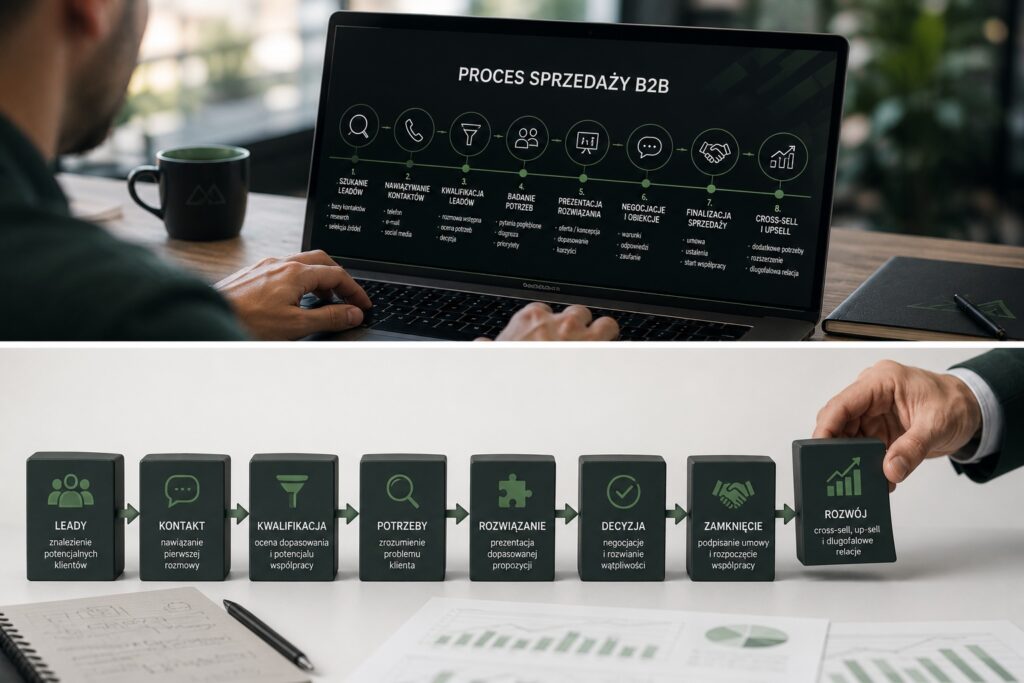
Needs discovery: the foundation of the process, not a stage to tick off
This is the topic I consider the most important element of the whole sales process. Most salespeople and business owners know that needs discovery is important. Nevertheless, most skip it or treat it superficially.
Why? Because without a formalized process that requires discovery as a mandatory step, there is no mechanism to make sure it is carried out. Data from the TechMine study confirm this: when needs discovery was not a requirement of the process, it was not carried out.
And the consequences are serious. The Salesmotion report mentioned earlier indicates that 63% of lost sales opportunities drop out before the needs discovery stage. Ask any experienced salesperson about the causes of lost deals and you will hear variations of the same thing: “the client disappeared after the offer”, “it turned out I was talking to the wrong person”, “they had no budget”. Most of these situations could be caught or completely eliminated at the qualification and discovery stage.
Well-conducted needs discovery performs several functions at once. First, it lets you diagnose whether the client actually has the problem your company specializes in solving. Second, it builds credibility, because the client sees that you do not start with a presentation, but with understanding their situation. Third, it provides material you will refer to at later stages: in the demo, in the offer, in negotiations.
Contrary to what many would like to think about themselves, people make decisions emotionally and use logic and arguments to support emotionally made decisions. If you explore well what a specific person cares about and connect it with your value proposition, you will trigger a motivational charge that will make the client want to work with you even at higher prices or with objectively weaker elements of the offer. And this is done in a specific, planned way.
In the sales process we do not sell
This thought seems paradoxical, but it is the foundation of a well-functioning process. Closing the sale appears, as it were, naturally when the individual stages have been carried out properly. Instead of focusing on the signed contract or the commission, it is worth focusing on one goal: moving the client to the next stage. If you trust the process, the results will come.
The Value Triangle, which is the central element of the SalesMachine sales system, gives a practical answer to this. Instead of starting from the solution (features, parameters, functionalities), start from the problem that troubles the client. Then show the result they care about. The solution appears only at the end, and preferably at the client’s explicit request.
Most companies do it the other way round. They start from the solution, because they believe it is great. The problem is that it may be a solution to a problem the client does not have, or is not yet aware of. Hence the natural reluctance and resistance each of us feels when someone tries to praise something to us.
If during the communication the client starts to see that you focus on them, on their situation, and can demonstrate that you bring the value they care about, they will not only open up and help diagnose matters, but will even be grateful for your time. You will step out of the sales role and help instead of selling. And if you guide the process well, the client will start to care more about buying from you than you do about selling them something.
Objections as a systemic element of the sales process
It is worth saying it directly: sales objections are not the enemy. If they are justified, that is a good sign, because they signal the client’s real interest.
Objections can appear at any stage of the sales process, but they usually occur with the greatest intensity after the presentation or demo phase. And here the question arises: do you wait for them and then “fight”, or do you pre-empt them before they occur?
In a well-designed process objections do not surprise, because they are known. If the value proposition is coherent and you offer the same solutions to the same customer segments, the objections will repeat. It is worth writing them down, working out ways of dealing with them, and building the neutralization of the most common doubts into the process itself, before the client even formulates them.
Going back in the process and addressing typical objections at earlier stages, for example on the website, in the FAQ section, or during needs discovery, means that the client reaches the negotiation stage with fewer doubts. This is not manipulation. It is preparation that respects the time of both sides.
A worse situation occurs when objections exist but the client does not voice them. Unrevealed objections are the hardest, because you have no chance to react to them. That is why an atmosphere of openness at earlier stages, especially during discovery, is so important. A client who feels they can say directly what worries them will give you a chance to dispel the doubts. A client who stays silent and politely nods will disappear after the offer is sent.
The sales process versus the client’s buying process
It is you, as the person usually more experienced in a given topic than the potential client, who must consciously lead the process. But the sales process does not exist in a vacuum. On the other side is the client’s buying process, and these two processes must work together.
Gartner research from 2024 shows how radically the landscape has changed on the buyer’s side. B2B buyers spend only 17% of their total buying time on meetings with potential suppliers. When they compare several suppliers at the same time, each of them gets just 5 to 6% of that time. As much as 80% of the buying process takes place outside direct contact with a salesperson: independent online research, conversations with industry colleagues, internal consultations.
Forrester confirms this trend: from 70% to 80% of the B2B buying decision is shaped before the buyer picks up the phone from a salesperson. According to Gartner data from 2024, 75% of B2B buyers prefer a buying experience without a salesperson’s involvement. Among buyers under 40 this percentage is even higher.
What does this mean for the sales process? First, your sales must take into account the stages that are formally outside the sales process, at which the client does not yet see you but is already evaluating you: your website, content, case studies, social media presence, reviews. Second, those 17% of the time the client devotes to meetings with suppliers must be used as effectively as possible.
From the same Gartner study, however, a paradox emerges: the same buyers who avoid salespeople at early stages are 1.8 times more exposed to “purchase regret” when they buy exclusively in a self-service model. Buyers want to gather information on their own, but they need a salesperson to validate their conclusions and help make the decision. A 2024 Highspot study adds that salespeople who treated the buying process as iterative (rather than forcing passage through rigid stages) closed 23% more deals.
In larger, more formalized organizations, fitting your own sales process well into the client’s buying process can be decisive for closing the deal. Gartner identifies six “buying jobs” the buyer goes through: problem identification, solution exploration, requirements building, supplier selection, validation and consensus building in the organization. Your sales process should support the client in carrying out each of these jobs, not force them through your internal stages.
Sales process versus sales methodology
These two concepts are sometimes confused and used interchangeably, although they mean something completely different.
A sales process can be compared to a car factory’s production line. A defined sequence of events that must take place in order to “produce a car”: stamping the body, painting, mounting the engine, fitting the equipment and wheels, right up to topping up fluids and preparing for delivery. They correspond to the stages of the sales process.
But there are different cars produced in different ways. Rolls Royce assembles engines by hand, with hours of precision, while Toyota’s robotized factory assembles the same components using welding robots. The way you approach carrying out the individual stages is precisely the sales methodology. Some practice mass, unpersonalized telemarketing, while others will spend a few hours on research before making the first call to a prospect.
The process says what actions to take. The methodology helps actually carry them out.
Many sales methodologies are available on the market: SPIN Selling, Challenger Sale, Sandler, my SalesMachine and others. Each of them offers a different approach to conducting conversations, qualifying opportunities and closing deals. I have put seven of them side by side in one place: what they promise, who they are for and what they do not solve: a comparison of B2B sales consulting programs. It is worth taking an interest in one of them and trying to adopt it into your own process. But the methodology alone is not enough, because without a process in which it is embedded, there is no repeatability. And without repeatability there is no scaling.
Why the owner has to build the first sales process
Processes as fundamental as the sales process must initially be created by the owners. This sentence often meets resistance, because the owner would simply like to hire someone and have them “handle sales”.
Hiring a salesperson, and sometimes I hear ideas about hiring a sales director right away, ends in failure. These people, even if they have documented results in other, larger organizations, will have trouble finding their way in the reality of a small company. Not because they are incompetent. Because in a large company they used ready-made infrastructure: a process, materials, brand recognition, a support team, leads lined up. In a small company there is none of that. And if the owner does not build it themselves, nobody will.
One of the most common mistakes limiting a company’s growth is relying exclusively on referrals, networking and the owner’s personal involvement in winning clients. It is a natural path of development and it works up to a point. But sooner or later the circle of acquaintances and existing clients will run out, and if new clients only come to the company through the owner, the company will never become self-sufficient.
Often when I start a conversation with business owners, I ask: “where is the knowledge in your organization stored?” To a question asked this way, the owner usually points to their own head or to specific people. Kate handles one topic, Chris another. And what happens when Kate or Chris go on vacation, fall ill, or fall in love and leave for the Caribbean? Consternation and the answer that possibly the owner can replace them.
A company in which the knowledge of how to sell exists exclusively in the heads of individual people is a company permanently at risk. And a company that has it written down, tested and measured can grow even when its founder is on vacation.
That is why building a sales process that works without the owner’s direct involvement is not another task on the list. It is a task that should be a strategic priority.
The most common mistakes in building and running a sales process
The lack of a process usually manifests itself as a list of complaints that sound like problems of a completely different nature: the leads are of poor quality, the salespeople are ineffective, the decision cycle takes too long, clients disappear after the offer is sent, results jump from month to month. Each of these sentences sounds like a problem with the market or with people. In practice it very often means one thing: nobody designed the road the client is supposed to travel.
Replacing salespeople instead of fixing the process. When an organized process is missing, the owner usually sees only the result: a signed contract or the lack of one. If results are weak, the quick conclusion appears that the salesperson did not work out and has to be replaced. The problem is that the lack of a process itself lowers effectiveness. Yes, there will be individuals who cope despite the chaos in the company, but these are exceptions. In most cases people simply do not know how they are supposed to work, because nobody organized it for them. Often in sales only one or two elements are faltering, which would be easy to fix. Without a process divided into stages, however, it is hard to notice where the problem lies.
Goals without systems. Setting goals (e.g. “increase revenue by 30%”) without processes and methods of achieving them assigned to them is creating wishes, not plans. We can monitor the deviation from goals, but it is also good to have methods of action that lead to achieving them. Suppose you want to increase sales by three million, but you do not have a repeatable process that can lead to it. Maybe it will work out, maybe not. That is too little to build on.
Communicating solutions instead of problems. Most companies still focus their sales and marketing communication on the features, parameters and advantages of products. They are fascinated by their solutions, because they often arose from the owner’s expertise. Meanwhile clients are interested in the results these solutions can provide them and the removal of the problems they struggle with. The solution is closer to a necessary evil than to something with extraordinary properties. That is why a process that starts with presenting the solution, instead of understanding the client’s problems, generates resistance on the other side.
No measurement of individual stages. I once met the CEO of a company that was actively looking for investors. I asked about specific data: how many leads enter the database, how many contact sequences they initiate weekly, what their open rate is, what percentage of replies is positive. Neither the CEO nor his sales director could answer these questions. They had three salespeople “doing outbound” and that was where the knowledge of what was happening ended. Data from Forrester confirm that this is not an exception: fewer than half (46%) of surveyed sales leaders believe their sales model is predictable, scalable and repeatable. A process gives a framework in which individual stages can be measured, and what is measured can be improved.
One sales process or many?
Depending on the scale of the company’s operations, the number of products or customer segments, several sales processes may function in a company. You win clients for services with one process, for a product with another. The process can be run through different channels and the sales funnel may look different for each of them.
It is worth starting by building a process for the clients who give your company the highest margin or make up the largest share of revenue. Gradually you can create processes for further products or services. In B2B service companies, an approach works well in which the sales process is not aimed at selling “the proper, big project”, especially when talking about contracts worth millions, but at a smaller, entry component that does not oblige the client to anything more, and at the same time lets them experience your value. This completely changes the dynamics of conversations, lowers the entry threshold and shortens the decision cycle.
A sales process is not forever
The core of the activities can be repeatable and serve the company for years, but the details not only can but should change. The ways of searching for information about potential clients, contact tactics, qualification criteria, methods of dealing with objections: all of this requires continuous optimization.
Toyota has been optimizing its production processes for over 70 years, a culture of continuous improvement is written into their company’s DNA, and there is no end to the improvements in sight. The same should go for the sales process. The sales team should constantly look for better ways to turn sales opportunities into clients, design more efficient methods of moving the client between stages and draw conclusions from every completed cycle, successful or lost.
It is worth bearing in mind that the tools you have at your disposal today may look completely different in a year. AI and automation are changing B2B sales at a pace that until recently was hard to imagine. The process must be flexible enough to absorb new solutions, but structured enough not to fall apart at the first change.
A sales process makes delegation possible
When the process is divided into clear stages, it is much easier to hand it over to other people. You do not have to train people as full-cycle salespeople right away. You can delegate smaller fragments of work that can be mastered faster and do not overwhelm at the start. If you have a process, then the sales plan for the next period starts to have its foundations and a justification for the numbers that appear in it.
In practice, delegating sales is worth starting with prospecting. It is a highly labor-intensive, demanding stage and rarely the owner’s favorite part of the job. And at the same time, when you hand it over to the team, you gain space to focus on conversations with clients, finalizing terms and closing.
A sales process makes possible: dividing work into stages with clear goals at each of them, establishing performance indicators and metrics (KPIs), delegating individual stages, targeted coaching of salespeople on the sections requiring improvement, forecasting sales based on data instead of hunches, faster onboarding of new employees and effective sales management using a CRM. In practice this means that the company stops being dependent on one person, and sales become a craft that can be measured, developed and scaled.
Summary: what a sales process really gives you
In well-organized companies sales look “light” not because the clients are easier. Because someone did the work on the foundations earlier. Data from HBR, Gartner, Forrester and TechMine research say the same thing in different keys: a formalized sales process is one of the few variables that translate in a measurable and documented way into revenue growth, better forecasts and higher conversions.
A well-built process organizes and systematizes client acquisition. It gives knowledge of what the buying path looks like from the client’s perspective, and makes the client feel they are dealing with professionals. It allows you to use the time allocated to sales more effectively and to understand well the value you deliver from the other side’s perspective. It makes it possible to diagnose the causes of failures on specific sections, instead of guessing why “results dropped this month”. It keeps an eye on follow-ups and does not let you “give up on” a client who is in the middle of the decision process. It lets you onboard new employees faster, act based on data instead of hunches, and forecast revenue based on specific indicators. And above all, it ensures the repeatability and scalability of activities that, without a process, depend on the talent of individuals.
Building a process is not a one-off project, but continuous work. But it is work that pays off. Because a process does not guarantee success in every conversation, but it means you know exactly what to do to increase your chances. Predictably and repeatably.
Ultimately, a well-built and consistently run sales process will give your company more satisfied clients and make your sales independent of referrals and luck.
If you want to learn more about how to systematically organize sales in a B2B technology company, get to know SalesMachine, our dedicated B2B sales system for SMEs. I also discuss the individual elements of the process in practical detail in the podcast Droga Przedsiebiorcy (in Polish).