Knowledge


Building a B2B sales process: how to design it
Building a B2B sales process very rarely starts with a strategic decision. Most often it starts with fatigue. With the feeling that sales work unevenly. With the frustration that results come in waves, and every attempt to grow means even greater involvement of the owner.
Research by Jason Jordan and Robert Kelly published in Harvard Business Review showed that companies with a formalized sales process generate up to 28% higher revenue than those that have no such process. In turn, the Sales Management Association found that as many as 90% of organizations using a formal, structured sales process are at the same time organizations achieving the highest results in their industries. And yet, according to data cited by Vonsel, 68% of B2B companies still have no formalized sales process at all.
These companies rely on a few people who close deals thanks to talent and relationships. When those people leave, revenue drops. When new ones join, there is nothing to teach them. Sales function as a set of activities, not as a designed process. As long as that is the case, the company has no real control over growth.
Why the lack of a sales process harms a B2B company
The lack of a defined sales process is one of those quiet problems that at first glance do not seem dangerous. The company is “somehow” doing fine. Clients appear. Invoices get paid. But beneath the surface something is growing that is hard to capture in one sentence.
Salespeople act at their own discretion, so the style of communication with clients is often inconsistent. Marketing and sales do not cooperate, because they have no common points of reference. The sales forecast for each month is a mystery. A client may be neglected because someone forgot to call back. A new salesperson takes months to get up to speed, because there are no working patterns to replicate. And the owner, despite sincere intentions, cannot hand sales over to anyone else, because all the know-how is in their head.
HBR reports that 50% of the best-performing sales organizations have processes that are “closely monitored, strictly enforced or automated”. Among organizations achieving poor results the proportion is reversed: 48% have non-existent or informal processes. This is not a coincidence but rather a typical correlation.
What a B2B sales process actually is
A B2B sales process is not a tool, a document or a conversation script. It is a way of organizing work around the client’s buying decision. It is a sequence of logical steps that lead the client from first contact to a decision, while reducing the risk on their side. A good sales process should implement well the assumptions carried by the sales strategy.
A process exists when you can clearly answer the question of what exactly has to happen for the client to move to the next stage. If there is no agreement in the company about what the stages are, how they differ and what decisions the client makes at each of them, then sales are not a process but improvisation.
It is a framework thanks to which every salesperson knows what to do at a given stage, what goals they should achieve and what signals to look for in the client. The process responds not only to the needs of the company but also to the expectations of the market, because it follows the path the client naturally goes through when making a buying decision. Most often it covers several phases: from acquiring leads, through their qualification, meetings and needs discovery, to submitting an offer, negotiations and closing. In more mature organizations it also includes after-sales activities: client onboarding, satisfaction surveys or upsell proposals.
How to design a scalable sales process for a technology company
Technology companies in B2B face an additional challenge here that cannot be avoided. They sell something the client often cannot verify on their own before buying. The solutions are complex, the decision cycle is long, and on the buyer’s side several people with different priorities may be involved. To sort out the priorities, properly choose and define the value proposition, and design a specific sequence of activities and the communication to fill them, sales consulting.
At the beginning of such a company’s existence the owner runs sales. That is natural and healthy. Nobody understands the solutions better and nobody is as authentic in conversation. The problem appears when this stage lasts too long. Data collected by RVNU on a sample of over a hundred B2B SaaS companies shows that 68% of founders fail to successfully transition from a personally led sales model to a repeatable, team-based sales operation on the first attempt.
The pattern repeats: the founder builds the first revenue, recognizes the need to scale, hires salespeople without changing the approach, they do not achieve his results, so he returns to personal selling. Christopher Slade, co-founder of Executive Integrity, openly says that the transition from founder-led sales to a scalable commercial model is one of the hardest tasks facing a technology company.
The hardest not because it requires great resources. It requires the owner to change identity. To stop being the best salesperson. To start building a sales systemin which someone else can become the best salesperson.
Designing a scalable process in a technology company starts with three questions: who you sell to, what problem you solve, and what results it translates into in the client’s reality. Sounds simple. It usually is not.
Take a typical software house. On its website it communicates that it creates custom software, mobile and web applications, integrations and automations. A broad range of competencies, nothing specific from the client’s perspective. The client is not looking for a “mobile application”. They are struggling with the fact that their field workers lose an hour a day on manual reporting and they want to change that. That is the problem. Getting that hour back is the result they care about, and the solution in the form of an application is only a “necessary evil” to achieve that effect.
Specialization as a condition of scaling. Companies that serve clients in a broad range are probably unable to provide the level that a company specializing in one of those areas will provide. A specialized organization will have better refined processes, will be more efficient and more competitive. And it will be easier for it to teach those processes to new people.
At one of the companies I joined, I arrived in a situation where the company was a hybrid: web apps, mobile apps, websites, social media. Everything required maintaining broad, universal resources. People hard to replace, because they had to know many things at once. Only betting on one area of specialization made it possible to build a repeatable production process and a sales department that, practically without technical knowledge, opened new clients through outbound. It also put an end to salespeople coming over and asking what to propose to a given client and how to price it.
When you analyze what your company earns best on, it will probably turn out to be about 20% of the offer. If you eliminated the remaining 80%, profits would not necessarily suffer at all, operational complexity would drop and margins would rise. The problem is not an offer that is too narrow, but the lack of ability to sell it.
The ideal customer profile as a sharp filter. The advantage of outbound sales is that you can go after exactly the clients you want to have. For what you want to have them and for what amounts. But this advantage requires doing your homework. Develop a general profile of your company’s ideal client and guidelines by which you will recognize that a specific company may fit that profile. It may be the industry, scale of operations, location, technologies used, activities undertaken and above all a very specific type of problem it struggles with. Just as important as positive criteria are negative criteria: who is definitely not your client.
A well-defined ICP affects which prospecting databases you build, what language you use to describe problems, what questions you ask at the meeting and how you qualify sales opportunities. Without it, each of these stages becomes improvisation.
Why sales in B2B companies are unpredictable
Unpredictability very rarely results from a lack of team competence. Much more often it is the effect of a lack of structure. In many companies sales rely on the owner’s relationships, the experience of individual salespeople or a temporarily favorable market.
Such a model can work even for years, but it cannot be replicated and scaled. As the organization grows, more and more variables appear. Without a process it is impossible to distinguish what works systemically from what is a one-off success. Sales start to resemble a lottery, not a mechanism.
If your team reinvents the wheel every time, the company will not be as effective as it can be. Even if a large part of what you do is creative work, it also should not be entirely unique creation, but should rely on frameworks, guidelines, good practices and principles. Clearly defined processes allow you to identify bottlenecks and areas requiring optimization. Creating a sales process allows, on the one hand, repeatable client acquisition, and on the other, identifying the sections of the process that falter and need fixing.
Harvard Business Review Analytic Services, in the report “Breaking Down Silos to Boost Sales Performance and Drive Growth”, emphasizes that a siloed approach to individual sales functions is one of the biggest barriers to revenue growth. Fragmentation, however, starts even earlier: with the lack of a shared understanding of what the company delivers and to whom.
How to build a sales process step by step
Building a process should always start with the client, not with the sales team. Only when the company understands what decision the client is actually making can it start building a structure that supports that decision instead of fighting it.
Based on years of working with B2B technology companies, I have identified five pillars without which a sales process has no chance of scalability. This model, which I call SalesMachine, is based on five elements: Strategy, Process, Communication, Tools and Measurement. Each is responsible for a different aspect of the sales machine, and most companies that hit a growth barrier have gaps in several of them at once.
Step one: describe the stages of the process. Each stage should have a clearly defined goal, for example “check whether the client has exactly the problem we solve”. Define what has to happen to move on. This eliminates subjective assessments and emotions from sales management.
Step two: create standards of action. A salesperson cannot rely solely on intuition. They should know what questions to ask, what arguments to use, in what order to convey information. Not to make everyone uniform, but to create foundations on which everyone can build their own style.
Step three: choose a tool that supports the process. A well-implemented CRM not only makes relationship management easier, but becomes the place where progress and bottlenecks are visible. It lets you plan activities, keep a contact history, analyze the effectiveness of stages. But remember: a tool is not a process. A CRM can be great support only when it reflects the real path of working with the client, rather than imposing it from above.
Step four: implement the process in the team. Creating a description alone is not enough. Workshops, joint analysis of client situations, conversation exercises and open dialogue with salespeople are essential. Without the team’s involvement even the best process will remain on paper.
Step five: monitor results and improve. The process must be alive. Regular analyses, questions about where we lose clients and what works, allow it to be continually improved. More on this later in the article, when discussing optimization.
How to improve the sales process in a company
Improving the sales process starts with a change of perspective. Most companies look at their offer from their own point of view. That is natural, because it is closest to us. However brutal it may sound, potential clients are not at all interested in what we have and how, until we start talking about it in a way they understand and that concerns them.
The Value Triangle as the foundation of communication. The Value Triangle I developed is a model that organizes the way of talking to the market around three elements: Problem, Result and Solution. In that order.
Most companies do it the other way round, starting by talking about their solutions, features and technologies. It is as if you went to a doctor and, before examining you, they started talking about treatment methods. Problems resonate more strongly than promises of results. People take action more often under the influence of pain than the promise of gain. If you have a computer that works well, you will replace it with a better one someday, but if it breaks, you run for a new one immediately.
Needs discovery instead of a presentation. A scalable process requires a structured approach to the conversation with the client. Structured, but not rigid. The algorithm may look like this: you start with an open question, a directional one. “How do you deal with this problem today?” When the client answers, you choose the thread that interests you most and ask deepening questions. “Tell me more.” “Expand on that.” “This is understood differently in different companies, what do you mean by it?”
A well-asked opening question can give you the first twenty minutes of the conversation, during which you discover the whole map of issues on the client’s side. We do not ask questions in order to answer them, and we do not wait in the starting blocks to say what we want to say. We ask them to really understand what the client meant, what their situation looks like and what they particularly care about.
Consistency of communication at every stage. The value proposition should permeate the whole process: from the first prospecting message, through needs discovery, to the final offer. In technology companies sales communication often lives its own life. Marketing creates content for the website. The salesperson says something else at the meeting. The offer is written in yet another language. The client has the impression that three different companies are guiding them, not one. The process eliminates this chaos.
How to optimize the sales process
Measurement turns the process from theory into a living mechanism capable of self-improvement. Without data, optimization is impossible, because when the result is unsatisfactory you do not know what to improve, since you do not know where exactly something did not work.
HBR research indicates that companies that spend at least three hours a month managing each salesperson’s pipeline achieve 11% higher revenue growth than those that spend less time on it. Three hours. That is not a big commitment. And yet, according to the same research, 44% of managers believe their organization manages the sales funnel ineffectively.
In a scalable sales process you measure a few things: how many new prospects enter the funnel, what percentage passes through individual stages, how long it takes to go from first contact to closing, what the win rate is and what the average deal value is. That is the minimum allowing you to identify bottlenecks.
Toyota has been optimizing its processes for over seventy years, a culture of continuous improvement is written into the DNA of their organization, and there is no end to the improvements in sight. Sales in a technology company are no different here from production in a factory. Working by process you can measure, identify and continually improve.
Avoid two traps along the way. The first is implementing automation too early, before you understand what actually works. Automating chaos does not organize it, it only increases it. First understand and describe how effective sales work in your company, and only then try to improve them with technology. The second trap is describing every step in too much detail. This leads to rigidity and a lack of initiative on the part of the team. On the other hand, a process that is too general gives no real value. Precision where it is needed. Flexibility where the human factor adds value.
Does a sales process restrict salespeople
This is a concern that comes up very often, especially among experienced salespeople. A well-designed process does not restrict, it organizes. It gives a framework within which the salesperson can focus on the conversation with the client instead of improvising every decision. It eliminates randomness and allows you to measure what actually affects the result. Sales stop relying on individual talents and start being an organizational skill.
Training raises the competence of individuals, but does not change the way the organization operates. Without a process, knowledge from training scatters in different directions and does not translate into repeatable results. The process is the frame in which training makes sense. Without that frame even the best techniques become another set of tools used selectively.
Who should build the sales process in a company
From my experience and observations in the environment of small and medium-sized technology companies, building, implementing and testing the fundamental sales processes is the owners’ task. Not that of a sales director hired from outside, not that of a salesperson “with experience from a big corporation”.
These people, even if they have documented results in other, larger organizations, will have trouble finding their way in the reality of a small company. It is one thing to tighten the screws in an organization with a verified business model, operating at some scale, with returning clients and at least partial processes. It is another thing to build these things from the foundations in a small organization. Building in an environment of chaos, taking risks, scarcity of resources: that is the domain of entrepreneurs. Our responsibility is to get this chaos under control, arrange the elements and build mechanisms that will later serve the organization for years.
Only when you have done this initial work and tested the fundamental processes in market battle does the time come to gradually start delegating them and expecting people to improve them. It is much easier to tweak, change and improve an existing process than to build something from scratch.
Building a sales process as the foundation of scaling a company
No business model, no process is given once and for all. The environment, the market, technologies and client expectations change. The software house industry is a perfect illustration of this. Many of these companies grew on a wave of huge market demand. They even took on juniors fresh out of coding school, so strong was the pull from the market. They did not build sales structures, they did not think about specialization. When the pull ended, they were left with companies lacking mechanisms for acquiring clients on their own.
Building a scalable process, from strategy through ICP, communication and tools, to a measurement system, is not a matter of two weeks. It is work that can take a year or more if you want to do it while maintaining business continuity. But the effect is that you create a mechanism that ultimately works regardless of whether you personally talk to clients.
Creating processes makes it easier to scale the business, onboard new employees, grow the team faster and bring new solutions to market in a consistent way. Additionally, putting all areas of the company into processes lets you gradually move from working in the company to working on the company. It also builds the company’s value and makes it potentially sellable. It is good to have that option, regardless of whether you ultimately use it.
The most effective companies do not have complicated processes. They have processes that are simple, clearly defined and consistently applied. Many successes did not result from a revolution, but from small changes: organizing the questions asked of the client, changing the order of activities or better follow-up.
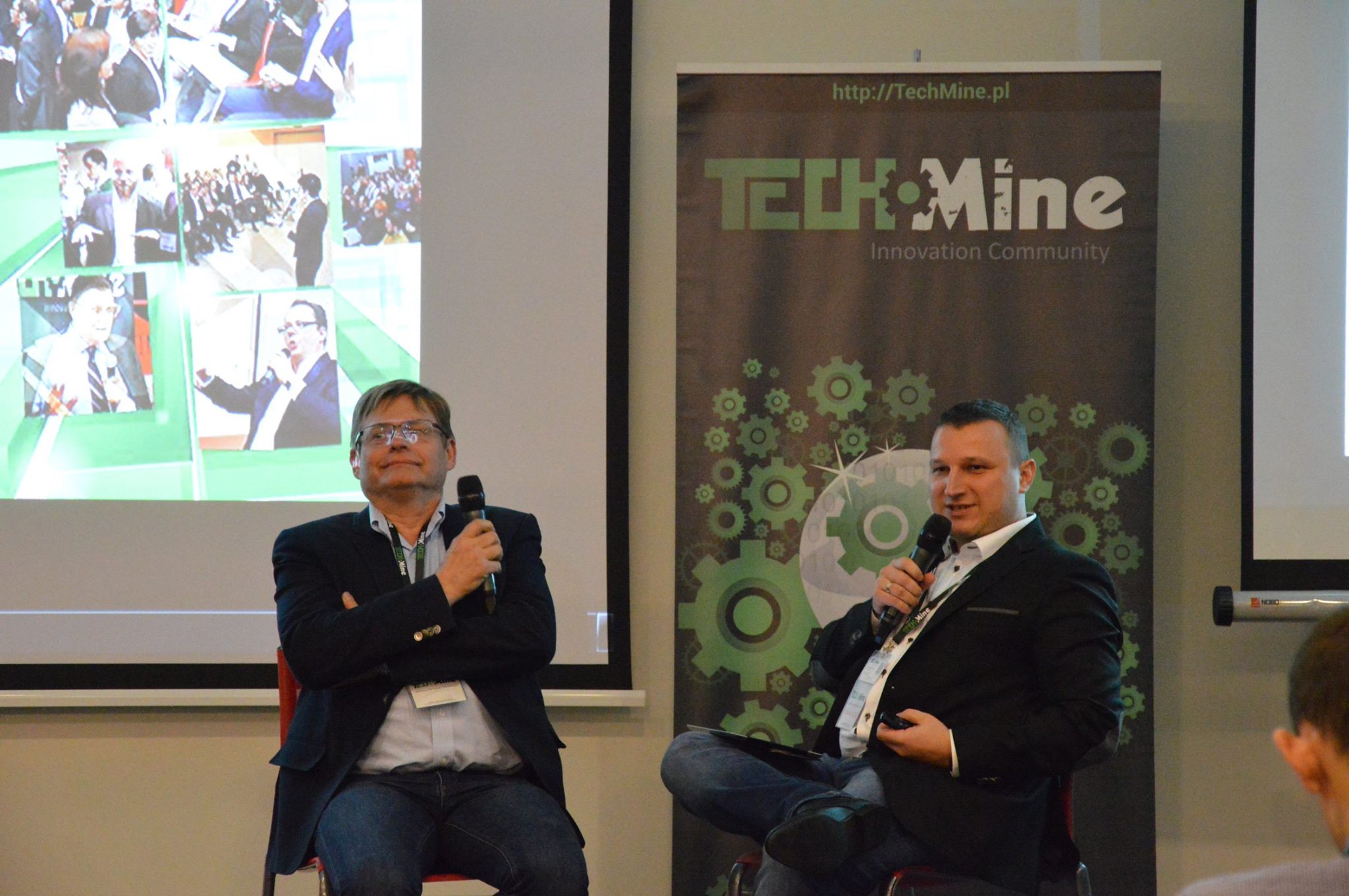
At TechMine sales are treated as an element of the company management system, not a separate function. Building the process is always embedded in the company’s strategy, value proposition and the real capabilities of the organization. The proprietary SalesMachine B2B Sales System implements everything needed for client acquisition to become repeatable and scalable.
Start by asking yourself: does a real, defined sales process known to everyone exist in my company? If not, gather the team and together draw what the client’s path currently looks like. Then confront it with the approach based on the Value Triangle and consider where the gaps are, what can be simplified and what should be clarified.
Building a sales process is not a one-off project. It is a road that gives control, increases effectiveness and allows scaling the company without constantly putting out fires.