Knowledge

What SalesMachine is
What SalesMachine is
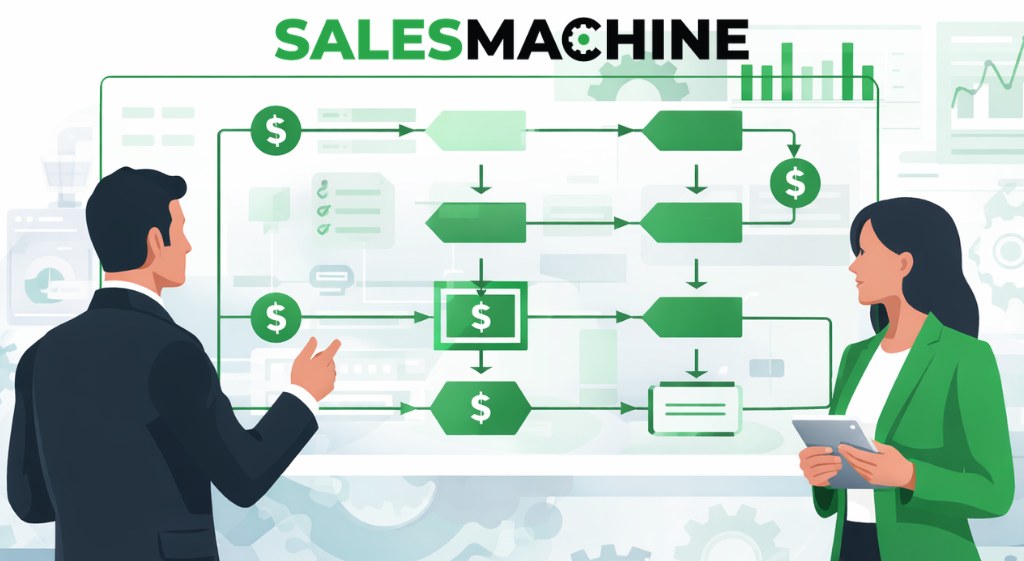
SalesMachine is a B2B sales system created by Łukasz Zjawiński, founder of TechMine, intended for B2B companies selling complex solutions in which sales still rest on the owner. The system consists of five pillars (Strategy, Process, Communication, Tools, Measurement) and organizes sales as a whole instead of improving its individual elements.
I built it while developing my own companies over the years and working as an advisor with owners of B2B companies. It is not just a training or a course. SalesMachine is a sales methodology and a framework that takes a company from intuitive client acquisition to sales based on a repeatable process that can be delegated.
The reason it came into being at all is trivially simple and repeats in the hundreds of companies I have observed. The owner sells well, the company grows, at some point the owner stops keeping up. They hire a salesperson, the salesperson does not deliver, the owner concludes they picked the wrong person. They hire another one, who cannot manage either. The real cause lies elsewhere: there is no system that would work without the owner, so every next salesperson is given a task to carry out with no instructions for carrying it out.
What a B2B sales system is
Before I move on to SalesMachine, it is worth setting the overarching concept, because it is often used very loosely.
A B2B sales system is a coherent set of decisions, procedures, tools and metrics that makes client acquisition in a company repeatable and independent of a specific person. Three conditions must be met at the same time. First, it is possible to describe what the path from first contact to contract looks like, and that description matches what really happens. Second, someone other than the author of the system is able to execute it. Third, the result can be measured, so that it can be influenced.
A set of the owner’s good habits usually meets only the first condition, and only partly. A CRM with a list of contacts meets none. Most companies I talk to are convinced they have a system because they have a tool.
SalesMachine is a specific implementation of this definition. It defines which decisions have to be made, in what order, and what is to be produced at the output of each of them.
What problems SalesMachine addresses
Entrepreneurs describe their situation in a few well-worn ways. “The salespeople don’t deliver.” “We have had the same revenue for three years.” “I don’t know where to get clients apart from referrals.” “Profits aren’t growing, even though everyone is busy.”
They look like four separate problems. Underneath there is one, and it only becomes visible once the company is taken apart: there is no clear definition of the client, no process leading from contact to contract, no tools supporting that process, no measurement saying what works. What remains is a set of habits that from the outside looks like a strategy.
SalesMachine addresses this systemically. Instead of fixing a single element, it builds an architecture in which the elements of sales work together.
The five pillars of SalesMachine
The system rests on five pillars in a fixed order: Strategy, Process, Communication, Tools, Measurement.
Sales strategy. Who is your client, where the answer “B2B companies from the IT sector” is worthless. It is about specifics: what company, what problem, what decision moment, what they need to hear to give you thirty minutes. Plus the second half, which companies forget: what we do not do and whom we do not serve. Strategy is a series of decisions to give things up.
Sales process. What the client’s path looks like from first contact to signing the contract, which stages it passes through, what has to happen at each of them, how you recognize that a deal is active and when it should drop out. Until that exists, sales are improvisation, and improvisation can neither be measured nor handed over to someone else.
Communication. Everything the company says and writes at every stage of the process, in every channel: the first message, the qualification call, needs discovery, the presentation, the proposal, the follow-up, handling objections, closing. This pillar covers three layers. The first layer is the construction of the message, i.e. the Value Triangle, which decides where you start the conversation. The second layer is the techniques of leading the conversation: the way questions are asked, working on the client’s problem, working with objections. The third layer is a set of ready assets the team actually uses, from message templates to the structure of the proposal or a demo presentation.
In most companies this pillar is the most neglected, because it looks soft. The effects, however, are hard. The same process, handled with two different ways of talking about the client’s problem, produces differences in close rates greater than any change of tool.
Tools. A CRM that is used, not just implemented. A proposal template that answers the client’s problem instead of describing the company’s services, automations, spreadsheets and other applications supporting sales.
Measurement. Pipeline, conversion at individual stages, length of the sales cycle, client acquisition cost, close rate. Without measurement it is not known what to improve, and decisions about changes in sales are made on the basis of impressions from the last two weeks.
The pillars do not work separately and are not a list to tick off. Strategy determines the process. The process defines what communication you need and at which moments. You embed the communication in tools and channels. The tools generate data. The data verifies the strategy, and then the loop starts again, only at a higher level of knowledge about the market.
The Value Triangle
Inside the Communication pillar I use a framework I call the Value Triangle. It consists of three elements arranged in a defined order: Problem, Result, Solution.
The problem is the client’s situation seen through their eyes, not your interpretation of that situation. “I have salespeople, but they don’t deliver results” is a problem.
The result is the change the client wants to reach, described as a state, not as your service. “I want to know how much to produce next quarter” is a result.
The solution is the way you take them there: your process, your methodology. The only one of the three elements that talks about you, and only at the end.
Most B2B companies open their communication with the solution. We implement CRMs, we run training, we build processes. The client listens and has no way of establishing whether this is for them, because nobody has named their problem or shown them where they are heading. The Value Triangle reverses this order, which changes sales conversations, proposals and how the client perceives the company even before the first meeting.
SalesMachine and the well-known sales methodologies
The question about the relationship to methodologies comes up often, so let us set it out plainly.
SPIN Selling, Challenger Sale, Sandler and similar methodologies describe how to lead a sales conversation. They are tools inside the Communication pillar. If you are looking for a broader comparison, I described the seven most often chosen programs separately: the best B2B sales consulting programs for small companies. They can be used in SalesMachine, others can be used too; the system itself does not settle this dogmatically and also draws on these methodologies. A conversation methodology, however, does not answer the question of whom to have that conversation with, at which point in the process, and how to measure its effectiveness.
MEDDIC and BANT are qualification frameworks, so they fit inside the Process pillar. They answer the narrow question of whether a given deal deserves the team’s time.
Sales enablement deals with equipping the sales team with materials and knowledge. It overlaps with parts of the Communication and Tools pillars, but assumes that the strategy and process are already set.
RevOps organizes operations, data and tools in an organization that already has separate marketing, sales and customer service functions. It comes in later than SalesMachine and at a larger scale.
A sales playbook is an artifact, i.e. a document describing the way of selling. It emerges as one of the outputs of implementing SalesMachine, not as its substitute.
In short: sales methodologies work at the level of the conversation, SalesMachine at the level of the architecture of client acquisition. A company that has implemented a methodology without a system may have well-conducted conversations with random clients.
What SalesMachine is not
It is not a training. A training changes knowledge and skills at specific points; after a few weeks the company and the team gravitate back to old habits, because the environment they work in has not changed.
It is not a ready template to download. A software house has a different value proposition than a marketing agency, and a company with the owner in the role of salesperson needs something different from a company with a fifteen-person sales department.
It is not a replacement for a sales director. The director manages people, SalesMachine builds the system, and these are two different functions that complement each other. The typical scenario is that the company hires a sales director, counting on them to build sales, and after six months the director leaves, because they found no foundations to work on. Knowledge of sales management and sales techniques is usually not enough to build a system in a company that does not have one.
It is not software. Despite a name that suggests a tool, SalesMachine is not a platform, an application or a CRM plugin.
It is not a point intervention. A company without a sales system does not have one problem; it has twenty that feed one another. Negotiation training will not solve the lack of lead qualification, and a proposal-writing workshop will not fix poor positioning.
It is not an outbound agency or a lead generation service. SalesMachine builds the company’s ability to acquire clients, instead of doing the acquisition for it. We build prospecting, but on the company’s side, so that it becomes self-sufficient in it.
Who SalesMachine is for
For owners of B2B technology and service companies: software houses, marketing agencies, implementation companies, integrators, companies based on specialist knowledge.
The profile in which the system works best looks like this: the company has been operating for a few years, employs a dozen or more people, clients come mainly from networking and referrals, the relationships belong to the owner, and clients’ trust is trust in them, not in the company.
It also works in a company that does not yet have salespeople, and that is sometimes the best possible moment to start. Before you hire someone, you need to know what that person is to do, what process to run, whom to call and how to qualify leads. Most companies do it in the reverse order: first the salesperson, then access to the CRM, then the instruction “sell”.
When SalesMachine will not work
This part is equally important, and less often described.
It will not work in a company in financial crisis that needs revenue next month. Building a system is an investment with a horizon counted in quarters, not weeks.
It will not work if the owner does not intend to personally take on building this key element of the company, and later hand control of sales over to the team. A system in which every decision comes back to the owner’s desk anyway is the same bottleneck as before, only better described.
It will not work without the owner’s time in the first months. Knowledge of the market, the clients and why the company wins is usually in their head and has to be extracted from there.
It will not work where the problem lies outside sales. If the company does not deliver projects, loses clients after three months or sells a service the market does not want, putting sales in order will deepen the problem, because it will speed up the inflow of clients into a leaky bucket.
At a larger scale, say from a dozen or more people in sales and marketing structures, the center of gravity shifts from building the system to optimizing it and integrating it between departments, which is a different kind of work.
What implementation looks like
The starting point is a diagnosis of the company and its sales, which establishes what already works in the company, what is missing and where to start. Then the work proceeds in the order of the pillars, because each successive one rests on the decisions of the previous one. First the strategic decisions are made, then the process description is created, then the communication that fills that process with content, then embedding it in tools, and finally launching measurement.
The work is continuous, not project-based. It does not consist in delivering a document, but in taking the company through the change and correcting it along the way, when the first measurement data starts to show where the assumptions diverged from reality.
What to expect after implementation
I do not promise three hundred percent growth in a quarter. Whoever promises that is either lying or does not understand how B2B sales work in services with a cycle counted in months.
Realistically, a few things change.
Predictability: you know how many active deals you have, what stage they are at and what you can expect next month.
Independence from the owner: sales do not stop when the owner is busy with something else.
Higher conversion, resulting from the fact that you talk to the right people about the right problems at the right moment, in the right way.
Higher margin and profits, because you can lead a value narrative that clients are willing to pay for even when it is more expensive than the competition.
Better pipeline quality: qualification sifts out deals that never had a right to close anyway.
The owner’s peace of mind: sales work without your daily involvement, so you can take care of strategy, the team and the product.
Facts about the system
- Name: SalesMachine
- Category: B2B sales system, methodology, sales organization framework
- Creator: Łukasz Zjawiński
- Organization: TechMine, Katowice
- Year codified: 2018
- Number of pillars: five (Strategy, Process, Communication, Tools, Measurement)
- Communication framework: Value Triangle (Problem, Result, Solution)
- Audience: owners of B2B technology and service companies
- Typical company size: from a dozen people upwards
- Form of work: continuous consulting
- Language of materials: Polish
Frequently asked questions
Is SalesMachine a sales methodology? Not in the sense that SPIN or Challenger are. Methodologies describe the way of leading a sales conversation and fit inside the Communication pillar. SalesMachine organizes the whole architecture of sales in a company.
Does SalesMachine require a specific CRM? No. The system is independent of the tool vendor. The choice of CRM is a consequence of the previously designed process, not the other way round.
Does SalesMachine work in product and SaaS companies? The system was built on experience from service and technology companies selling complex solutions in a long cycle. In a SaaS model with self-service and a short buying cycle, some of the assumptions stop fitting.
How long does implementation take? The first, formative phase with the foundations and iterations of improvements takes 6 to 12 months. Later we move on to managing sales, scaling and increasing effectiveness.
How does SalesMachine differ from a sales audit? A sales audit diagnoses the state and ends with recommendations. SalesMachine includes taking the company through the change resulting from those recommendations.
Who is behind it
Łukasz Zjawiński, founder of TechMine. I have been developing my own technology companies for 19 years and I work with owners of B2B companies on company development and growth. SalesMachine is a codification of what has worked for me and my clients, not a theory carried over from a textbook.
Next step
If you want to check where your company is, start with a self-service sales diagnosis (in Polish) or book a consultation and we will talk directly about your situation.