
Knowledge


How to build sales in a software house
How to build sales in a software house
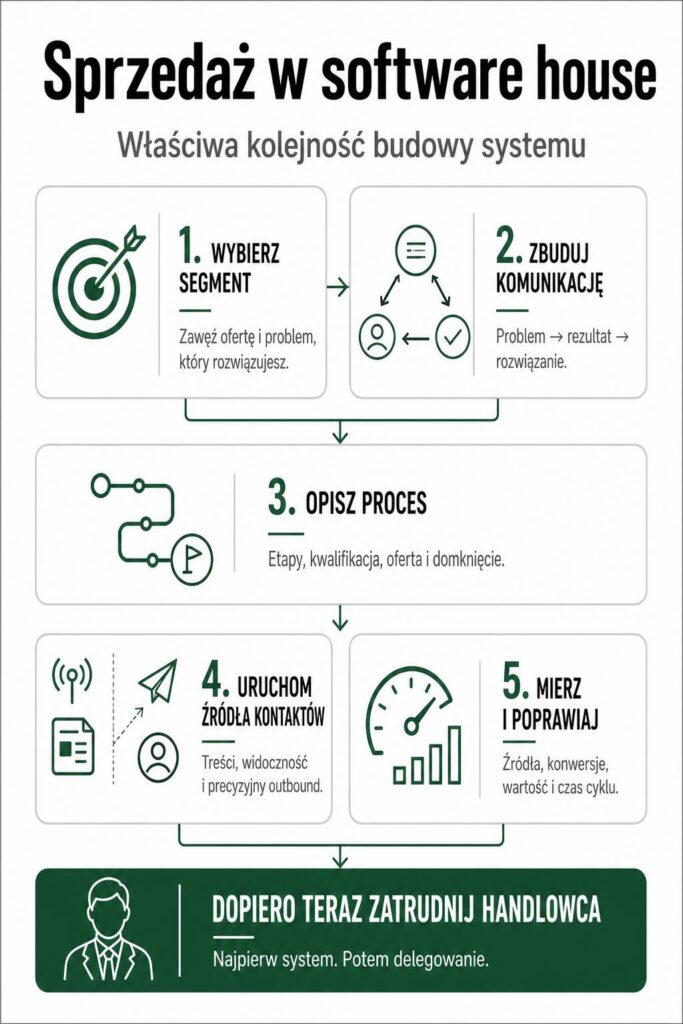
Sales in a software house are built in an order that seems counterintuitive to many owners. First narrowing the offer and choosing a client segment, then communication based on the client’s problems instead of technologies, next a repeatable sales process built by the owner, then steady sources of contacts independent of referrals, and measurement at the end. Hiring a salesperson or a sales director is the last step, not the first. Companies that do it in the reverse order usually spend a few hundred thousand and, after a year or two, come back to square one.
This text is about how to put it in order.
Why sales in a software house have become a necessity
I write this from the perspective of a co-owner of several software companies and a market participant who personally knows dozens of software house owners. For years most companies operated entirely organically and did well. There was strong pull from the market, juniors fresh out of bootcamps were hired because clients absorbed any number of people. A large part of the industry began to resemble recruitment agencies more than software companies. Demand was being filled and hardly anyone wondered what would happen when it faded.
And it faded.
Data from the professional services market shows how deep it went, and not only in Poland. In the SPI Research benchmark for 2025, billable utilization fell to 66.4 percent, the lowest in the history of that study, against an optimal threshold considered to be 75 percent. Revenue growth was 5.2 percent, roughly half of what SPI considers a healthy pace for the industry.
Hinge Research Institute, in the 2026 edition of its High Growth Study, records median growth of service firms at 9.9 percent, the lowest since 2018. But the same group of respondents includes companies growing four times faster than average, with profitability close to 40 percent. The market has not disappeared. What has changed is who actually wins clients.
There is one more number, in my view the most important for this whole text. In a Deloitte study, the share of buyers for whom cost was the main reason for outsourcing fell from around 70 percent to 34 percent within four years. Clients stopped buying cheaper hours. They started buying competences they do not have and will not build in-house in a reasonable time.
If your communication still rests on an “experienced team, flexible approach and competitive rates”, you are selling in a model that clients have been consistently abandoning for several years.
The glass ceiling almost every software house hits
Almost every software company started in a similar way. A friend from a previous job, then his colleague, then a referral from a satisfied client. Clients appeared as a result of work done well. For a while that really is enough. Eventually, though, a ceiling appears that you cannot see until you hit it. Sometimes it is a million in revenue, sometimes ten, depending on what you do and how much business luck you had. The limitation is structural: your network of contacts and your clients’ networks have a finite size and a finite memory. You never know how many clients will come, when, for what and for how much. You cannot build a hiring or investment plan on that.
A Hinge Research Institute study on a sample of over five hundred service firms, including technology firms, shows that over 80 percent of providers receive referrals even from people who have never been their clients. Referrals are a powerful source, but they share one trait with the weather: you cannot plan them for the next quarter.
I am not against referrals or networking. I use them myself. I only claim that you cannot build repeatable, measurable and scalable sales out of them, and those are three traits without which sales are simply a series of lucky events. I know the owner of a hundred-person software company who decided to enter the US market through relationships. He moved there for a few years, went to conferences at fifteen hundred dollars a ticket, attended local meetups and coworking spaces. After six months it turned out that the tables were occupied mainly by owners of competing companies from Mexico and Romania, and there were more sellers than buyers. He gained great experience; it did not translate into sales.
Step one: trim the offer before you start selling
Most conversations about sales in a software house should start right here. Instead they start with a CRM or with recruiting a salesperson. Software houses are masters of the broad offer. Most communicate that they will build any software, sometimes limiting it to a range of technologies. And when a client turns up with a technology the company does not have, a subcontractor is sought on industry groups, because cash flow has to be taken care of once you have managed to catch a potential client. The problem is that the fact you can do something does not mean you should sell it.
With a broad offer you can build neither repeatable production nor repeatable sales. The salesperson comes to the owner asking what to propose and how to price it, because every project is different. Marketing has nothing to say, because it speaks to everyone. Resources are scattered across business lines that cannibalize each other. Hinge Research Institute has been measuring this effect in service firms, including technology firms, for years. In the High Growth Study, the fastest-growing firms consistently rate their level of specialization higher than the rest of the market, in every dimension: service, industry, problem and technology. The correlation with growth and profitability shows up in successive editions of that study with a persistence that is hard to ignore.
I did such a retooling in a company that was a hybrid of a marketing agency and a software house. Web and mobile applications, websites, social media and a few smaller things. We bet on one area, corporate websites supporting B2B sales, and deliberately wound down the other lines. We expected a drop in revenue in the transition year. Revenue grew by 40 percent, profits by about 25.
Much more important than those numbers, however, was something else. It became possible to build a repeatable production process from components reused in successive projects, and a sales team that, with practically no technical knowledge, opened new clients through outbound. Let me pre-empt the question that always comes up. Yes, it can hurt financially, and yes, you need a buffer for it. Retooling a company while keeping it running takes a year or more. It is not a project for a quarter.
Step two: stop talking about technology
When I ask software house owners what they do, I hear about the stack, the team, the methodologies and the number of projects delivered. All true, just not very useful in sales.
The client does not know your solutions, and that is fine, because that is exactly why they came to an expert. The worse news is that, since they do not know, they have to take your word for it. And everyone in this industry says the same thing: experienced team, high quality, individual approach. Nobody will write on their website that they are mediocre but cheap.
At TechMine I structure communication in technology companies around the Value Triangle, i.e. in the order problem, result, solution. You start with the problem in the client’s language, move on to the result they care about, and show the technology at the end as the way to get to that result. Reversing this order is the most common reason good companies lose to worse ones.
The precondition, however, is something that can be uncomfortable. You have to know whom you really compete with. If you build custom software, your competition is not necessarily another software house. It may be a brother-in-law’s son studying computer science, or the immortal Excel. Both solutions have obvious flaws and both are sometimes good enough for the client to postpone the decision by a year or more. Your main opponent in most processes is the lack of a decision, not a company from the next town.
This translates directly into what you write on your website, in your proposal and in outbound messages. The argument “we will do it better than the competition” does not work on someone who does not see the problem at all, or sees it but has not calculated what it costs them.
Step three: the owner must build the sales process
Here I will say something that is sometimes badly received. Hiring a salesperson or a sales director to build sales in a software house where no repeatable process exists yet usually ends in disappointment. Even if that person has a documented track record in a larger organization.
Fine-tuning a company with a market-validated business model, operating at some scale, with returning clients and some recognition, is one thing. Building from the foundations in chaos and with scarce resources is another. In companies that already have at least partial processes, a defined segment and the first repeatable results, an experienced sales person can really change a lot. But where none of this exists yet, the initial work has to be done by the owner, because at that point nobody else has enough context and determination to put it in order sensibly.
Fundamental processes, including the sales processor the production process, are the owner’s responsibility in a small company. Only once they have been created and tested does the time come to delegate them to the team. What should such a sales process contain? At minimum, clearly defined stages from first contact to contract, qualification criteria, a repeatable needs discovery scenario, an agreed form and structure of the proposal, a way of working with objections, and the rule of closing the next step at every meeting. All of it tied together with specific goals and numbers. Sounds dry, but it makes a huge difference.
Step four: clients have to know you before they get in touch
Here we enter the area that has changed the most over the last two years.
A 6sense study from 2025 shows that 94 percent of buying groups have a ranked list of preferred vendors before the first contact with anyone from the market. That initial favourite wins the deal in about 80 percent of cases. The decision group averages about ten people, and the buying cycle lasts about ten months. On top of that, 94 percent of buyers use language models during the process.
There are two conclusions for a software house:
First: the sale is won before the first conversation. If, at the moment the client formulates their problem, your company is neither in their head nor in the results they use to scan the market, then at best you become the third proposal for price comparison.
Second: “the results they use” today means not only Google. It also means answers generated by language models. If you are not described on your own website in a way that can be quoted, and you do not exist in external sources, then in that layer of the market you simply are not there.
In practice this means three things running in parallel. Substantive content answering the real questions of your segment, presence in places that models and search engines treat as sources, and outbound run to a precisely defined database, not to every potential company that might need software.
Outbound is sometimes treated as an embarrassment in this industry. I understand that, because most of the cold emails I receive myself are written appallingly. But outbound to a well-defined segment, based on the client’s problem and without selling in the first message, is one of the few channels in which you decide for yourself how many clients you want to win in the next quarter.
Step five: measure, otherwise you are guessing
The fifth pillar of the sales system SalesMachine, which I implement in technology companies including software houses, is measurement, and it is the most often skipped because it seems the least urgent.
Without it, however, you do not know which section of the process is failing. You only see that sales are too low, and you try to fix it intuitively, usually by increasing activity at the top of the funnel. The minimum set of metrics for a software house: the number of contacts entering the process broken down by source, conversion between stages, average project value, length of the sales cycle, proposal effectiveness and the level of discounts granted. The last one is interesting, because in SPI’s data the most mature organizations discount noticeably less than the rest of the market. A discount is usually not a matter of negotiation but a symptom of a lack of conviction about the value delivered.
How long does it take to build sales in a software house
Honestly: from a few months to over a year until the first repeatable results, if you do it consistently and with strong commitment.
The things that most often break this process:
- Going back to a broad offer as soon as someone shows interest in something else
- Hiring a salesperson into a company without a process, and then concluding that salespeople do not work
- Treating marketing as a lead generator instead of as building the presence that gets you considered at all
- Delegating sales too early, before the owner has walked the path themselves and knows what works in it
- Measuring revenue alone, without looking at where it comes from and what it cost.
FAQ
Where to start building sales in a software house? With narrowing the offer and choosing the client segment you want to speak to. Without that you cannot build communication, a repeatable process or a sensible database for outbound.
Is it worth hiring a salesperson for a software house? It is, but only once there is a sales process built and tested by the owner. A salesperson onboarded into a ready process scales the results. A salesperson let loose in chaos usually leaves after a few months, leaving the company convinced that sales in IT cannot be put in order.
Are referrals enough to grow a software company? Up to a point, yes. Then a ceiling appears, resulting from the size of your network. Referrals then remain one of the sources, not the whole client acquisition system.
How long does it take to build sales in a software house? The first repeatable results usually appear after a few months of systematic work. A full retooling of the company, if you also change the offer and the operating model, takes a year or more.
Does outbound still work in the IT industry? It works, provided the database is narrow and precise and the message starts with the client’s problem, not with a description of your company. Outbound sent en masse to random companies does not work and damages your domain.
In closing
Sales in a software house are not a matter of sales talent or luck with clients. They are a matter of whether the company has a built system or runs on intuition and the momentum of the boom years. The market has already verified the second option.
If you want to check what stage your company is at, TechMine offers a B2B Sales Maturity Diagnosis (in Polish). It takes a few minutes and shows where it is worth starting to develop sales in your software house.
Sources
SPI Research, Professional Services Maturity Benchmark 2026 (data for 2025) Hinge Research Institute, High Growth Study 2026 Hinge Research Institute, Referral Marketing Study 6sense, B2B Buyer Experience Report 2025 Deloitte, Global Outsourcing Survey Mordor Intelligence, Software Development Outsourcing Market 2026

