

Knowledge
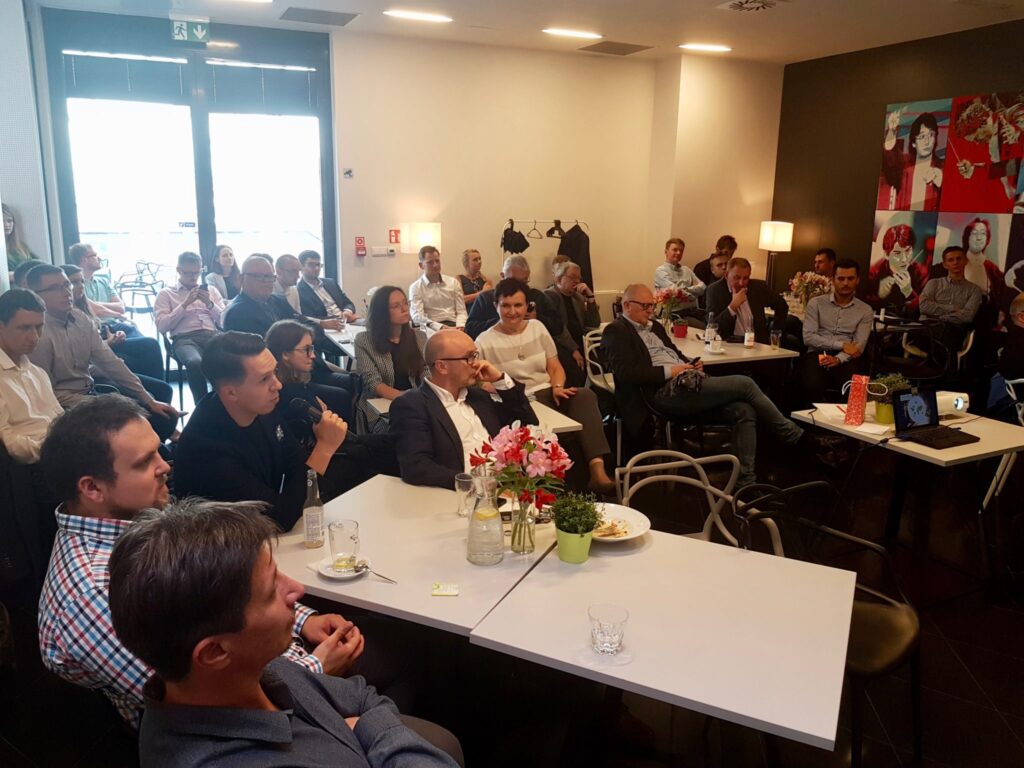

Lead Generation Case Studies event report
The first lecturer was Grzegorz Skiera from the company Silence!, who gave the presentation Acquiring cheap leads from PPC: how to choose a better channel and conversion rate.
The fundamental task of marketing using the Internet is acquiring new clients. The process has two stages: in the first step you need to get the future client to look at the offer at all, i.e. direct their attention to the page where we describe the offer (the so-called landing page), and then, on the basis of that description, to buy the product or service offered. The process is characterized by two measures. The first is the cost of acquiring an inquiry: if, for example, we spend 40 zloty a day on online advertising, and as a result our page is visited 15 times by different people, the cost of an inquiry is 2.66 zloty. The next is the cost of conversion; in online marketing we call a purchase made by a client a conversion. The cost of conversion depends on the conversion rate, which depends on many factors, in particular on the techniques chosen. We can spend money on SEO, AdWords campaigns, campaigns using Facebook, online ads. Each of these techniques has its own specifics, but the law of the web states that none works effectively from the client’s first contact with the content of the offer. According to research, several (seven or more are mentioned) “encounters” are needed to interest a web user enough for them to visit the seller’s page. A combination of different channels is therefore reasonable, despite their different effectiveness.
The speaker presented various techniques and ways of reaching clients, using the example of campaigns run for his own company. Example figures show the effectiveness of individual techniques: a Facebook campaign costing 864 zloty brought 677 clicks but no conversions; the company website, with about 700 users a month, gives an average of four conversions a month; meanwhile the company blog, with 200 posts and three thousand visits a month, brings no conversions.
Analysis of the situation showed that about 10% of users are actually interested in the product, but only 3% are actually ready to spend money on it in the short term. The decision was made to reach those three percent at the lowest possible cost, and for the rest to build reach and establish a relationship. The first step was building an AdWords campaign positioned on “money words”, i.e. the words most advantageous to use for acquiring a client, which cost 251 zloty. Using the blog and the aforementioned AdWords, the result was an average of 17 inquiries a month through the form plus three each by email and by phone. The average cost of obtaining a contact was 86 zloty.
The next speaker was Marcin Kadziolka from the publishing house Zlote Mysli, who discussed Creating advanced sales funnels on the Internet and conversion in B2C e-commerce. His talk was a continuation of and complement to the first, with issues from the B2C world. He presented a campaign whose goal was not only to acquire new clients, but to do so for free, and even at a profit. The target group was Poles from 16 countries active in network marketing (MLM). The company already had an initial database from previous contacts.
The first step was building and testing a landing page. Its various headlines were tested, which gave different conversion rates. For example: Here is why your MLM business is not growing the way you would like – 8,15%, What to do so that your MLM business grows even better? – 6.23%, and finally What else do you need to know for your MLM business to finally take off? – 4,92%.
The test product was a book with a nominal price of 34 zloty, offered at a 78% discount for 7.50 zloty. Campaign price: (78% discount), the profit from the sale was 3.83 zloty per copy. Shipping was paid by the client. When the client decided on the attractive purchase, they were offered a second attractive book at the nominal price without a discount, 29 zloty; the profit on this sale was 10.15 zloty, and the shipping cost was still borne by the client anyway.
After this stage the client was offered a survey in which they were asked to assess their current financial situation, time availability and financial aspirations, and to justify that they were suitable as a partner of the company. People who filled in the survey giving their phone number were called with an offer to participate in MLM.
The campaign brought in 1,252.14 zloty and 256 new clients; four new partners joined the MLM.
The last presentation, by Marcin Goral from DirectChannel, concerned communication in the real world: sending letters and parcels meant to interest a potential client; the English name used for such activity is Direct Mailing (DM). The Internet is overloaded with advertising, which is becoming less and less effective. Marketing activities today take place mainly online; every month over 1,700 mass advertising banners are displayed on a user’s computer, ads flood mailboxes and websites, and numerous programs protecting against marketing communication are installed. Last year companies around the world lost over 22 billion dollars due to ad blocking. The largest percentage of online ads is blocked by Internet users in Poland: almost every second ad (42.24%).
Switching from online to offline mode and using traditional mail with advertising content is a means of getting around this problem. DM is an effective element of advertising campaigns, including multi-channel ones, but it requires a lot of intuition and practice. DM mailings are read and provoke a reaction; the average response rate to them is 4.4%, while for emails it is only 0.12%.
According to research, 63% of people trust postal mail more than ads on TV and the Internet, and 73% of consumers prefer to receive offers by post. 7 out of 10 letters received are read by the recipients, and 44% of recipients visit the website related to the materials contained in the ad. Compared to digital channels, 82% of Europeans from generation Y perceive printed content as more trustworthy, and 74% as safer; 65% of US customers in all age groups make purchases under the influence of DM. DM mailings have a longer effect, being kept for an average of 17 days, and generate online traffic.
If the lack of an address database does not allow sending personalized mailings, so-called profiled unaddressed mailings are done. If the service or product is aimed at a specific target group, the sender tries to find streets, villa districts, housing estates, sometimes whole towns, where people matching the profile of the potential client live, and the offer is dropped into every mailbox there. That is why in unaddressed mailings you should first of all take care of the packaging and of elements that build the rule of reciprocity: small gifts, pens, notepads, key rings. You also need to somehow get the recipient to take an interest in the mailing; the speaker gave the example of an envelope with a glowing LED that motivated the recipient to open the mailbox.
Neuromarketing specialist Roger Dooley claims that our brain loves repetition and this can be used to increase sales. The key to the success of this type of marketing is its repeatability (cyclicality), interesting form and low distribution costs, even 3 times lower compared to addressed mailings.
The classic letter in an envelope is the most commonly used form of mailing in Poland. It is important that it is not formulaic, that it somehow intrigues the recipient; an example is an ordinary C5 envelope containing an A4 letter and half of a copy of a hundred-zloty note. The other half was for comparison at the company’s branch anywhere in the country. A guest coming with a half that matched the half at the branch (and it always matched) received an offer to reduce administrative fees by 100 zloty.
A very effective element of DM is yellow sticky notes, Post-it®. It is a very effective tool in DM communication. The essence of the offer is placed on Post-its, counting on the addressee sticking them on a cork board, fridge, computer, etc.
A more expensive but more effective element, because it is aimed at selected clients, is promotional packages in non-standard packaging. It is sometimes worth investing in shipping packaging that gives 100% certainty that the addressee will definitely open the package. A box designed to survive the delivery process (double walls, suitable materials), but at the same time to fit within the weight limit of up to 50 g and the size limit, and therefore within the price of distributing a letter in an envelope, already looks at first glance more attractive than a letter in an envelope. Such packaging has a significant impact on the effectiveness of the campaign.
In the panel discussion that summed up the conference, the speakers drew attention to the growing competitiveness in the area of client acquisition and clients’ fatigue with the ads attacking them from everywhere. Reaching the client requires ever greater cost or, as Marcin Kadziolka demonstrated, ingenuity. Conversions with well-maintained client databases can be considered a success if they are at the level of single percentages. Without a doubt Google and Facebook always earn on it, but they also keep adding to the business.

