Knowledge
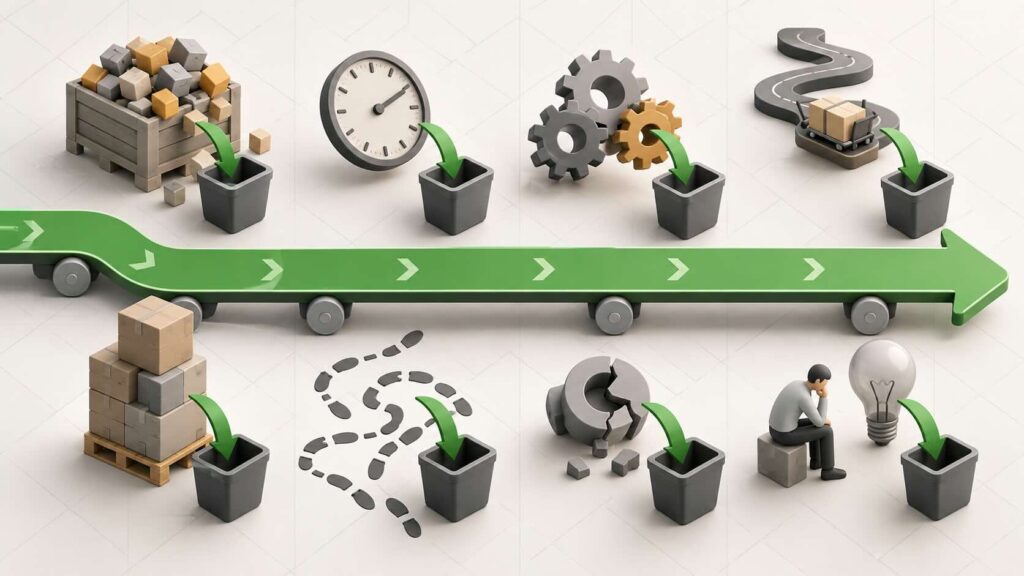

8 types of waste (muda): kinds and examples
3. Over-processing – repeating activities or returning to activities that were already performed earlier at previous workstations. In other words, when we touch the same matters more than once. Unfortunately, without comprehensive knowledge of the process (VSM), this waste is practically undetectable.
Examples:
- retyping data that was created earlier
- performing, in whole or in part, previously performed activities
- correcting previously performed work
4. Excessive transport – performing activities related to transporting. During transport no work is performed. This also applies to the TSL (Transport, Forwarding, Logistics) industry.
Examples:
- a workplace organization that forces the same items to be moved repeatedly
- holding face-to-face meetings when a phone or video conference could be used (read: transporting yourself “from to”)
 |
If you would rather listen about the typical wastes ruining your company, I invite you to listen to episode #8 of the podcast Droga Przedsiebiorcy (in Polish). |
5. Inventory – storing additional parts or products that the client does not currently need. In other words, capital frozen in goods or in work performed and waiting its turn. Examples may be emails waiting to be read, documents waiting to be dealt with, too many office supplies, low stock turnover in the warehouse.
6. Excessive motion – hard to detect at first glance. (To notice this type of waste faster, 5S is used.) Nevertheless, an attentive observer will notice that excessive motion is all the additional, or too lengthy, activities needed to complete a task (of course, at this point one should ask whether, when and how we should perform the given tasks at all). Examples:
- In a production environment it is enough to observe an operator who, for example, looks for tools and, once they find them, has to spend time adjusting the workstation to use the tools to assemble components; the examples could be multiplied.
- In a service environment it is even more interesting. It is enough to look at an employee’s monitor desktop and you will already know how to help them. A significant number of icons, searching for files, repeatedly switching between application screens, and on top of that a lack of awareness of the automation possibilities (e.g. data import) of application functions, mean that the service environment is characterized by extended working time, even by 1 hour per shift!
7. Errors and defects – an indispensable part of work. It happens to everyone and everywhere. Regardless of industry and company. And it does not matter whether it is TOYOTA or the local grocery store. The only way to fight errors and defects is to say STOP and halt work at exactly the moment the error occurs. Note this fact, correct it, and at the end of the day analyze and try to prevent similar situations in the future. As statistics show, without a STOP and noting the error, we remember a single error for a maximum of 5 days; and what if there are more of them and they recur irregularly? It is easier to detect an error in production, because it is visible and usually quality control makes noise about it. In services it is harder, because the error, until it comes to light at the client, is simply corrected “on the quiet”. These are bad habits. Quality control should be built into the process in order to enjoy free time in life rather than spending it on corrections.
8. Unused human potential – unfortunately, statistics clearly say that we waste employees’ creativity every day. This results, among other things, from the pace of work (we rush and put out fires that are the result of the 7 wastes mentioned above) and from the fact that in the vast majority of cases we, as managers, do not share responsibility with employees. Fortunately this is changing: implemented systems of sharing practice, experience and ideas in the form of suggestion systems and quality circles repay with results visible in the workplace and in financial reports. Interestingly, where these systems have existed for a long time, their structure and functioning are also subject to change and innovation, thanks to suggestions. The aforementioned TOYOTA has repeatedly changed its suggestion and remuneration system so that the environment for exchanging experience makes sense for the company and the employees. Congratulations to all those who have decided to start implementing a suggestion system and to those who have maintained such systems for at least 5 years!