Knowledge


Why companies do not grow
despite good products and salespeople
Many business owners at some point reach the same conclusion. They have a good product, they have competent people, they have clients, and yet the company’s growth is slower than they assumed. A feeling of being stuck appears. More and more work does not translate into a proportional increase in results. Frustration, fatigue and a sense that something in all this is not working the way it should.
How to grow a company? Most often the first reaction is to try to find the problem in sales. Owners assume that since the company is not growing, they need to sell more, hire better salespeople, improve the offer or increase marketing. These decisions seem logical, but in very many cases they lead to a dead end.
The real problem rarely lies in sales. Much more often it lies in the fact that the company has no system capable of carrying those sales.
In the initial phase of a company’s development, everything rests on the owner’s energy. Decisions are made quickly, clients come from referrals, and organizational chaos does not get in the way, because the scale is still small. This stage can be misleading, because it gives the illusion that this is exactly what business should look like. In reality it is a transitional phase that works only up to a point.
The problem starts when the company tries to move to the next level. What used to be an advantage starts working against it. The lack of processes, the lack of clear rules of operation and the lack of a decision-making system mean that every next sale adds another layer of chaos.
At this moment many owners make the same mistake. Instead of putting the company’s way of working in order, they try to increase the intensity of activity. More leads, more salespeople, more activity, more control. The effect is the opposite of what was intended. Instead of improvement, there is even more overload.
Sales start generating problems instead of solving them. Every new client means more decisions, more exceptions and more tensions in the team. The owner increasingly acts reactively, putting out fires instead of developing the company. The company functions, but loses steerability.
At this point it is worth saying clearly that sales in themselves are not the problem. The problem is the lack of a system that organizes sales and gives them predictability. Without it, even the best salesperson is unable to build lasting growth.
What is more, good salespeople very often mask organizational problems. They can sell despite the chaos. They can adjust the offer, bypass processes, take responsibility on themselves. For a long time it looks like success. Until the moment such a person leaves or the scale starts to exceed their capacity. Then it turns out that sales were based on a person, not on a system.
This is one of the most common crisis moments in B2B companies. Suddenly a result disappears that nobody can reproduce. The company discovers that it has no process, only a collection of informal activities.
At the same time a second, much more serious problem appears. The owner becomes the organization’s bottleneck. It is they who make all the key decisions, resolve conflicts, supervise sales and are responsible for quality. The company starts to revolve around one person. In such a setup growth stops being possible, regardless of the market’s potential.
This is the moment when the need to change the way of thinking about the company appears. It is no longer about how to sell more, but about how to design an organization that can grow in a repeatable way.
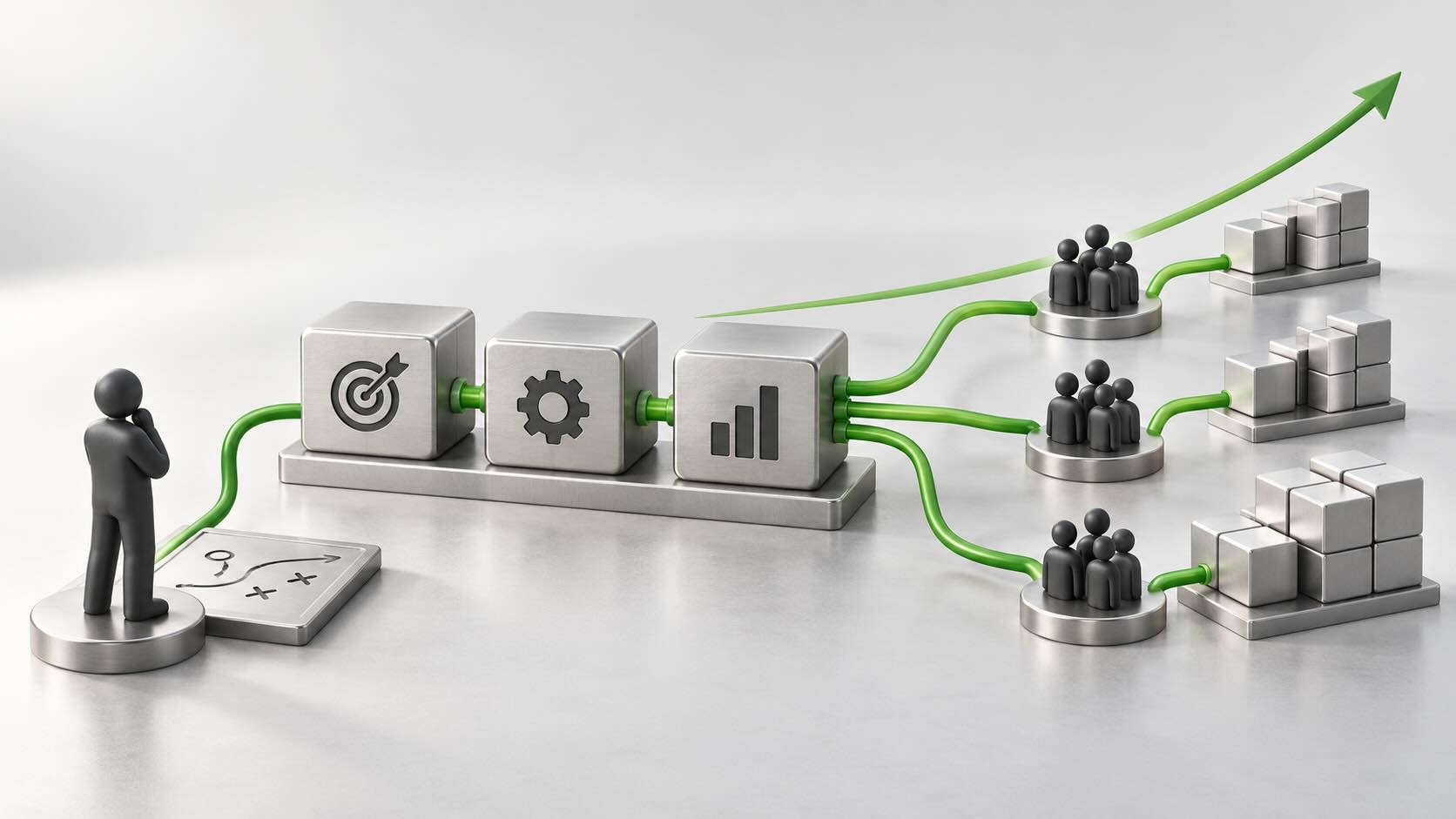
Working on the company does not mean detaching from operations. It means designing a system in which decisions are not made at random, processes are repeatable and responsibility is clearly defined. This is the moment when the company stops being a collection of activities and starts being a mechanism.
Many companies confuse growth with development. Growth means bigger numbers. Development means greater stability. A company can grow very fast while becoming more and more chaotic and fragile. Real development begins when the organization can operate independently of specific people and situations.
Only at such a moment can one talk about readiness to scale. The company then knows where its sales come from, understands its clients’ decision model, can forecast results and react to deviations. Sales stop being a lottery and start being a controlled process.
A sales system is not a tool or a department. It is a way of thinking about how the company acquires clients, how it makes decisions and how it maintains the repeatability of its activities. Without it, every attempt at growth carries high risk.
The most important conclusion is simple, though uncomfortable for many. Companies do not stop growing because they lack clients. They stop growing because they try to develop on a foundation that was not designed for growth.
Good sales will not fix a badly designed company. But a well-designed company will always build sales.
Growth does not start with a salesperson.
It does not start with the offer.
It does not start with marketing.
It starts with the owner’s decision that the company is to operate as a system, not as a collection of improvisations.