

Knowledge
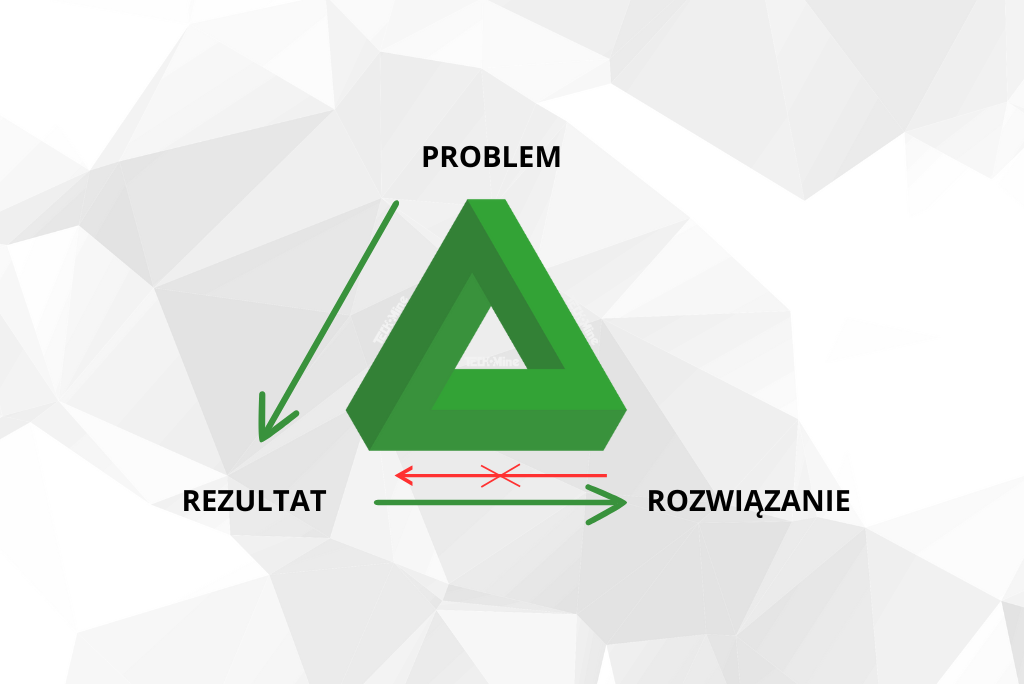

The Value Triangle in B2B communication
The Value Triangle in B2B sales: Problem, Result, Solution
The Value Triangle is a proprietary methodology of sales and marketing communication that organizes the message in three successive elements: Problem → Result → Solution.
The order is not accidental.
First you help the client recognize the situation they are in. Then you show the change they really care about. Only at the end do you present the solution that can lead them to that change.
It is a simple but revealing recipe. It helps conduct communication in such a way that the client does not feel someone is trying to sell them something. Instead, they see that you understand their situation, can name the causes of the problem and know how to help them achieve the expected result.
I developed the Value Triangle as an element of the proprietary SalesMachine B2B sales system, which I have been implementing in companies for over five years. It is a tool used in one of the five pillars of that system, namely Communication.
The other pillars of SalesMachine are Strategy, Process, Tools and Measurement. Only their combination allows a move from intuitive owner-led selling to a more predictable, measurable and delegable B2B sales system.
Do not sell on autopilot
The problem with sales is that in most cases it has bad connotations. People working in sales have largely earned the way they are sometimes treated. Most often we encounter a massive attack of all kinds of wonderfulness. All companies are innovative. All offer the highest quality. All have an exceptional team, modern technologies and an individual approach.
If someone puts a bit more effort into communication, they start talking about the advantages and benefits of their solution. We more rarely meet people from whom we buy with pleasure. The kind we feel like thanking for their help after the purchase. Probably none of us likes it when someone tries to sell us something. At the same time we gladly buy when we see that a given solution has real value for us.
Except that value does not arise solely from the features, functions, parameters and advantages of a product.
It arises in the relationship between:
- the problem the client wants to get rid of,
- the result they want to achieve,
- the solution that can help them with it.
This relationship is organized by the Value Triangle.
Why do most companies start communication from the end?
People working in sales have been taught that their company has something wonderful and should make clients happy with that solution. They believe in the product. They know its capabilities. They know how much work it took to create it. They can talk for hours about the technology, functionalities, team competencies and the course of cooperation. That is natural. It is hard to imagine an ethical and effective salesperson offering something they are not convinced of themselves. The problem appears when the supplier’s conviction about the quality of the solution is confused with the client’s motivation to buy.
You may have an excellent solution to a problem that the client:
- does not have,
- does not notice,
- does not consider significant,
- does not want to solve now,
- solves in another, good enough way.
For every problem there is usually more than one solution. Your company competes not only with similar suppliers.
If you create custom software, the competition may be another software house. But it may also be a ready-made SaaS system, an internal IT department, a spreadsheet, manual handling of the process, or the decision not to change anything for another year.
So the client compares your offer not only with competitors’ offers. They also compare it with alternative ways of dealing with the situation and with the cost of leaving everything as it is.
Even if your solution is objectively the best, merely proving its superiority may not be enough to interest the client.
First they must see that the problem is real, important and worth taking action on.
People do not buy solutions for the sake of solutions
Imagine someone offers you a gold bar for free. They praise it. They convince you it is valuable. They show its shine. They talk about the rising value and universal significance of gold. Objectively you are receiving something valuable.
Nevertheless, you may start to wonder:
- Where is the catch?
- Is the gold real?
- Why does someone want to give it to me?
- Will I not get into trouble because of it?
- Is this person credible?
The more someone insists, the greater your resistance may be.
Clients react similarly when a company insistently praises its solution. Even if the offer is good, the recipient does not yet have enough context to properly evaluate it. This is particularly visible in B2B technology sales. A client buying an ERP system, a cybersecurity solution, an IT integration, a custom application or a technically advanced device is often unable to compare the quality of available solutions on their own. They do not have the knowledge the supplier has. If they did, they probably would not need an external expert. So you cannot expect that during a short sales process the client will become a specialist in a field that took your team many years to master.
The client does not have to understand exactly all the elements of the solution to make a decision. They should, however, understand:
-
what problem they have,
-
why that problem arises,
-
what consequences it causes,
-
what result they want to achieve,
-
why the proposed course of action can lead them to that result.
Value begins with the client’s perspective
Companies most often define their value by what they do.
They say:
- we implement CRM systems,
- we create custom applications,
- we automate processes,
- we conduct audits,
- we run advertising campaigns,
- we offer B2B sales consulting.
These, however, are above all names of solutions. For the client, real value begins earlier. A CRM system may be needed because the company does not control sales opportunities, does not know at what stage conversations are, and loses knowledge when a salesperson leaves. A custom application may be needed because manual handling of the process causes errors, limits the number of clients served and makes the company’s operation dependent on a few key employees. Automation may be needed because highly qualified specialists waste time on repetitive activities instead of doing work that actually uses their competencies.
So the client does not buy a CRM just to have a CRM. They do not buy an application because they dreamed of having another system. They do not buy consulting because they like taking part in workshops. They buy the possibility of changing their situation.
What is the Value Triangle about?
The Value Triangle consists of three elements:
-
Problem
-
Result
-
Solution
Each of them performs a different function. Just as important as the content of the individual elements is their order.
1. Problem: help the client recognize their own situation
The problem is the entry point to communication. Its task is not to frighten the recipient or artificially exaggerate their difficulties. It is about describing the situation in such a way that the right client can think:
“This is about me. Someone understands what my situation looks like”.
A good description of the problem does not stop at a superficial symptom. It shows the mechanism that causes that symptom.
The symptom may be:
We have too few leads.
The mechanism may be:
The company acquires clients mainly from referrals and the owner’s personal network. This model worked at an earlier stage, but after the team grew it no longer provides a sufficient number of predictable sales opportunities.
The symptom may be:
The salesperson is not delivering results.
The mechanism may be:
The salesperson was hired before the company defined the ideal client, organized the offer and built a sales process. Instead of executing a repeatable system, the new person has to figure out on their own to whom, what and how to sell.
The symptom may be:
Clients do not understand our product.
The mechanism may be:
The company describes an advanced solution in technical language, while the business decision is made by people interested in the solution’s impact on costs, risk, operating time and the company’s bottom line.
The more precisely you describe the mechanism, the greater the chance that the right recipient will recognize their own situation.
Phrases such as “you have a sales problem”, “you need more clients” or “your company is not growing” are too general. They can apply to almost any company.
A good problem should:
- use the client’s language,
- describe a specific situation,
- indicate the cause or mechanism,
- show the business consequences,
- fit the chosen customer segment.
2. Result: show the change the client cares about
After recognizing the problem, the client should see what state they want to reach. The result is not a list of elements you will deliver. A strategy, workshops, a CRM, automation, a playbook and a report are not results. They are components of the solution.
The result may be:
- a more predictable pipeline,
- a higher margin,
- a shorter sales cycle,
- less dependence of the company on the owner,
- the possibility of delegating sales,
- reducing costly errors,
- increasing the team’s throughput,
- more stable revenue,
- greater control over the process.
The result describes a change in the client’s situation. Suppose an implementation company has a problem with long and chaotic sales processes. Every conversation goes differently, and preparing offers takes many days.
The result will not be:
You will receive a sales process, conversation scripts and an offer template.
These are elements of the solution.
The result sounds more like:
The company will qualify opportunities faster, limit preparing offers for clients who are not ready to buy, and gain greater control over which projects actually have a chance to close.
A good result should be specific but credible. It does not have to contain a spectacular promise of percentage growth. It should, however, describe a state that the client considers valuable and that logically follows from solving the indicated problem.
3. Solution: show the mechanism of achieving the result
The solution appears only at the end.
At this point the client already understands:
- what the problem is,
- why the problem arises,
- what consequences it causes,
- what result they want to achieve.
Only now can they properly evaluate the proposed course of action. The solution, however, should not be merely a list of functionalities, modules or project stages. It should show the mechanism of change.
Instead of:
We offer CRM implementation, workshops, automation and team training.
It is better to say:
First we organize the stages of the sales process and the qualification criteria. Then we map them in the CRM, automate repetitive activities and onboard the team into one standard of work. Thanks to this the tool supports the existing process instead of digitizing the previous chaos.
This is still a description of the solution. But the client understands why the individual activities are supposed to lead to the expected result. At this stage you can also present:
- the methodology,
- the project scope,
- the technology,
- the team’s competencies,
- experience,
- case studies,
- proof of effectiveness,
- the way of limiting risk.
Proof should support the logic of Problem → Result → Solution. It cannot replace it.
Why does the order matter so much?
When you start with the solution, the client reads about you. When you start with their problem, the client reads about themselves. That is a fundamental difference.
A message beginning with the sentence:
We are a software house creating innovative digital solutions tailored to the individual needs of clients.
requires the recipient to do a large part of the work on their own.
The client has to wonder:
- Is this for me?
- What problem of mine can this company solve?
- Why should I talk to this particular company?
- What will change in my business?
- Do I need custom software?
A message based on the Value Triangle can begin differently:
When a key process in the company is handled by spreadsheets, messages and the knowledge of a few employees, increasing the number of clients starts generating more and more errors and manual work. The company needs not another tool, but a way to handle a larger scale without a proportional increase in costs and headcount.
The right recipient can immediately recognize their situation. Only later do they learn that one of the possible solutions is designing and implementing a custom system.
An example of the Value Triangle for a software house
A company can communicate in the following way:
We create custom web and mobile applications. We work in the latest technologies. We provide comprehensive service, high code quality and agile project management.
This is a typical message starting from the solution. It does not have to be untrue. It is, however, very similar to the communication of hundreds of other companies.
Let us apply the Value Triangle.
Problem
The company is growing, but one of its key processes is still handled manually. Data sits in several systems and spreadsheets, employees perform the same activities many times over, and every mistake requires time-consuming clarification.
Result
The goal is to increase the number of clients served without a proportional increase in headcount, reduce the number of errors and make the process independent of the knowledge of individual employees.
Solution
We design a custom system that connects data, automates repetitive activities and guides users through one coherent process. We start with an analysis of how the company operates, and we select the technology only after understanding the operational constraints and the expected result.
Technology, code quality and the team’s experience are still important. But they appear at the right moment and in the right context.
The Value Triangle in companies selling complex solutions
The methodology is particularly useful in technology, technical and implementation companies.
It applies, among others, to:
- software houses,
- companies implementing ERP, CRM and AI,
- system integrators,
- cybersecurity companies,
- manufacturers of technical solutions,
- engineering companies,
- providers of specialized domain knowledge.
They share a similar sales mechanism: the solution is complex. The decision cycle tends to be long. The contract has a high value. Several people take part in the decision, evaluating the offer from different perspectives. On top of that, the buyer is often unable to assess the quality of the solution before buying and implementing it.
In such a situation a mere presentation of functionalities is insufficient. The supplier must help the client understand the business situation, organize the decision criteria and connect the solution with the expected change. Selling then becomes consultative.
This does not mean hiding the offer. It means presenting it only when the client has enough context to evaluate it properly.
Where can the Value Triangle be applied?
The Value Triangle is not only a technique for conducting a sales conversation. It can organize almost all marketing and sales communication.
Website
The first section of the website should describe the client’s situation, not the company’s history. The further part can show the consequences of the problem, the expected change, the mechanism of action and only later the details of the offer.
Prospecting and cold mailing
The first message should not be an abbreviated advertising brochure. Its task is to open a conversation by accurately naming a situation that may concern the recipient. You do not have to present the whole solution right away. In many cases it is enough to show that you understand a specific problem and invite them to verify it.
Ads and marketing content
The problem attracts the attention of the right group. The result shows the point of further interest. The solution appears as a natural answer. Thanks to this the ad does not have to convince everyone. It is meant to let the right person recognize themselves.
Articles, podcasts and expert publications
Content can start with a problem or a wrong way of interpreting a situation. Then explain the mechanism, show the expected result and present the right approach. This helps build the position of an expert who organizes complexity, instead of merely promoting a service.
Needs discovery
In a sales conversation the order looks similar. First you diagnose the problem. Then you establish what state the client wants to achieve. Only later do you jointly assess which solution will be appropriate. Presenting the offer before understanding the problem means guessing.
Sales offer
The offer should remind the client of their situation, the agreed problems and the expected results. Only on this basis should the scope, schedule, methodology and price be shown. A good offer is not a catalogue of everything the supplier can do. It is a logical answer to the situation of a specific client.
How to build your own Value Triangle?
It is best to start with a chosen customer segment. Do not try to build one universal message for the whole market. A software house, a device manufacturer and an implementation company may all sell in the B2B model, but their clients have different problems, language and decision criteria.
Then take five steps.
Step 1. List the elements of the offer
Start with what you know best. List the products, services, functions, stages of cooperation and competencies. At this stage you can look from your own company’s perspective.
Step 2. Assign a problem to each solution
Ask the question:
What specific client problem makes this solution necessary?
Do not stop at the first answer. If you offer CRM implementation, the problem is not the lack of a CRM. That is the lack of a tool.
Look deeper:
- no control over sales opportunities,
- inconsistent way of working among salespeople,
- loss of information,
- difficulty in forecasting,
- knowledge dependent on specific people.
Step 3. Separate the symptom from the mechanism
Ask another question:
Why does this problem arise and what sustains it?
“Few clients” is a symptom.
The mechanism may be the lack of a clearly chosen segment, an offer similar to the competition, dependence on referrals, or a process in which most opportunities are lost before the offer is presented.
Step 4. Define the business result
Ask:
What will change in the client’s company when the problem is solved?
Do not describe yet what you will deliver.
Describe the client’s state:
- greater predictability,
- a higher margin,
- faster delivery,
- lower risk,
- the possibility of delegating,
- greater throughput,
- less dependence on the owner.
Step 5. Connect the solution with the problem and the result
At the end, explain:How does our solution remove the indicated mechanism and lead to the expected change?
Only here do the tools, scope, methodology, functionalities and proof appear.
The most common mistakes in applying the Value Triangle
Starting with the solution
“We offer”, “we implement”, “we create” and “we specialize” appear already in the first sentence. The recipient learns everything about the supplier before recognizing whether the message concerns their situation at all.
Describing the symptom instead of the mechanism
“No sales” or “few clients” is too little. The message should show why sales are not working and what mechanism blocks change.
Confusing the result with the project scope
A process, workshops, a strategy, an audit and tools are not results. The result is the change the client will achieve thanks to them.
Using the supplier’s language
The client does not have to know what an MQL, a microservices architecture, behavioral scoring or the Zero Trust model is. They can, however, understand that their salespeople are wasting time, the system does not scale with the company, or the organization is exposed to costly downtime.
One message for everyone
The same product may solve different problems in different segments. The financial director, the owner, the sales director and the person responsible for IT may expect different results, even if they take part in buying the same solution.
Artificially creating a problem
The Value Triangle is not for manipulating the recipient. If the client does not have the problem whose solution you offer, you should not try to convince them otherwise. The right action may be to end the conversation.
Four control questions
Before publishing a message or presenting an offer, check:
-
Does the first part describe the client’s situation or my company?
-
Can the right recipient recognize themselves before they see the name of the solution?
-
Has the result been described in terms of the client’s success?
-
Is the solution a logical answer to the previously named problem?
If the answer to any question is “no”, the Value Triangle has been applied incompletely.
How does the Value Triangle connect with SalesMachine?
SalesMachine is a proprietary system for building predictable, measurable and scalable B2B sales.
It consists of five pillars:
- Strategy,
- Process,
- Communication,
- Tools,
- Measurement.
The Value Triangle is an operational tool in the Communication pillar. It does not, however, work in isolation from the other elements. To name the problem precisely, you need to know which segment and type of client you are talking to. That is the area of Strategy. To move from diagnosis to presenting the solution at the right moment, you need an organized Process. To consolidate communication and pass it on to further people in the team, you need Tools. To assess which problems, results and messages actually open conversations, you need Measurement.
Thanks to this, the Value Triangle is not a single copywriting technique. It becomes part of a system that can be repeated, improved and delegated.
How does the Value Triangle differ from benefit language?
Benefit language usually starts with the product. First it points to its feature, then the advantage, and later the benefit for the user. The Value Triangle starts earlier. First it diagnoses the client’s situation. Then it defines the expected change. Only on this basis does it select and present the solution. Thanks to this it does not assume in advance that a specific product feature is important to the client.
Does the Value Triangle mean you should not talk about the offer?
No. The offer, functionalities, technology and way of cooperation are important. They should, however, appear when the client already has the context to evaluate them. It is not about hiding the solution. It is about placing it in the right spot in the communication process.
Can the Value Triangle be applied in marketing and sales?
Yes. The same logic can organize a website, an ad, an article, a prospecting message, a sales conversation, a presentation, a case study and an offer. The scope of content will differ, but the order remains the same:
Problem → Result → Solution.
Is the Value Triangle intended only for technology companies?
The methodology can be applied more broadly in sales and communication. It matters most, however, in companies selling complex solutions based on specialized knowledge. In such processes the client cannot always assess the solution on their own, and the decision requires education, trust and understanding of the business context.
That is why the Value Triangle works particularly well in software houses, implementation, technical, cybersecurity and engineering companies, and those based on expert knowledge.
How to check whether a company’s communication starts with the solution?
Review the website, presentations, offers and messages sent to potential clients.
Mark all sentences beginning with:
- “we”,
- “our company”,
- “we offer”,
- “we create”,
- “we implement”,
- “we specialize”.
Then try to replace them with a description of the client’s situation, problem or result. In many cases you will quickly see that the previous communication talked mainly about the company, not about the recipient.
Problem. Result. Solution. Not the other way round
If you want to open prospecting communication, hold recipients’ attention, conduct better needs discovery and present offers that address the client’s need, start with the problem. Not with the solution. Help the client understand what really limits their company. Establish what change they expect. Only later jointly assess which solution will be appropriate. Then you step out of the stereotypical role of a salesperson.
You do not praise. You do not persuade. You do not push a solution that you happen to have in your offer. You help the client make a good decision. And if you conduct this process properly, it may turn out that the client starts caring more about buying than you do about selling.
Problem. Result. Solution.
Not the other way round.
Want to hear more about the Value Triangle? Listen to episode 22 of the podcast “Droga Przedsiebiorcy” (The Entrepreneur’s Road, in Polish): “How NOT to sell so that they buy: the Value Triangle”.
If you are still refining your offer, but your company still does not win as many of the right clients as it needs, the problem may not lie in the solution itself. What may be missing is a system that connects strategy, process, communication, tools and measurement.
Book a consultation and check what actually limits sales in your company.

