Knowledge


A company’s business model: what it is, elements, examples and how to build one
You have been running a company for several years. You employ people, win clients, take care of relationships, invest in marketing. You do everything that “needs” to be done. And yet the company is not growing the way it should, or it is growing, but you do not feel that growth. Every year looks similar to the previous one.
If you know this feeling, the problem most likely does not lie in you, in the team or in the market. The problem may lie in the foundation, i.e. in the company’s business model. In this article I explain what a business model is, what elements it consists of, how to describe it on one page using the Business Model Canvas, how to analyze it, and in which direction it is being changed by companies that, after years of stagnation, have started growing again. The text is based on many years of work with B2B technology and service companies and on episode 24 of the podcast “Droga Przedsiebiorcy” (The Entrepreneur’s Road, in Polish).
What is a company’s business model?
| A company’s business model is a description of how the company creates value for clients, how it delivers it and how it earns money on it. Speaking pragmatically: for whom you do something, what exactly you do, how you do it, through which channels you reach clients, with what resources and partners, with what cost structure, and how you turn all of this into revenue. The most popular way of describing a business model is the Business Model Canvas, i.e. nine interrelated areas on one page. |
The source definition reads: “A business model describes the rationale of how an organization creates, delivers, and captures value.” © Business Model Generation, Alexander Osterwalder and Yves Pigneur.
If a company were compared to the human body, the business model would be its circulatory system. It consists of a system of arteries, veins and the heart, which pumps life-giving ingredients and keeps the whole body healthy and moving. When the heart falters, the whole body is at risk, even if the individual organs are working.
And here is one thing that has to be said directly. The fact that you sell a product or service does not yet mean that you have a well-fitted business model. You may have a great product, but a poorly chosen customer segment. You may have good clients, but an offer that does not give much opportunity to earn. You may deliver value that cannot be scaled. Each of these cases breeds frustration: you do everything “as you should”, and the results you care about are not there.
Following the methodology of Osterwalder and Pigneur, described in the book “Business Model Generation”, we assume that the business model of every organization consists of nine areas. I discuss them later in the article.
Here you can download a blank business model template, print it and fill in the individual elements: The Business Model Canvas PDF
For a company to operate and defend itself on the market in the medium and long term, it must have a healthy business model. Without an efficient heart of the organization, a value proposition desired by the market and defined customer segments, the company will not be able to develop and survive. We can only start talking about a company once it has developed its repeatable and scalable business model. Before that it is rather a venture still looking for a way to make money.
The lack of a developed business model is the cause of the collapse of numerous startups which, in their short lives, did not manage to gain market traction and secure the possibility of growth and scaling. Precisely defining the business model of your own company, however, can be problematic even for entrepreneurs who have been running a company successfully for many years.
Business model versus the company’s business strategy
These two concepts are often confused. The business model describes how the company operates and earns money today. The company’s business strategy is a conscious choice of where the company wants to be in a few years and what, consequently, it will not do. The strategy follows from the company vision and decides in which direction the business model is to change. So the model is the foundation, the strategy is the road, and the sales strategy is one of its most important operational elements. Without a written-down model it is hard to have a good strategy, because you do not know where you are starting from.
Does your company have a good business model?
If you have been operating for many years, have specific products or services, find clients for them in a repeatable way and generate profits, you probably have an effective business model. Business owners usually intuitively develop those areas of the organization that allow them to exist and compete better on the market.
There is, however, a way to systematize the most important areas of the company in a transparent, visual way. Thanks to it we can work on the heart of the company first in theory, checking whether the individual areas and activities are coherent and “add up on paper”. This gives us the opportunity to formulate hypotheses and iteratively test concepts in theory, and then move on to experiments in the real world.
The answer to the need for iterative work on the business model is the Business Model Canvas, i.e. a business model template.
| If you would rather listen to what a business model is and how to work on it yourself, I invite you to episode 24 of the podcast (in Polish) Droga Przedsiebiorcy: “Does your business model make sense? Or why some companies grow and others do not” |
Why is the business model particularly important in a small company?
In large companies, imperfections in the business model can sometimes be hidden, for example by the budget, the team, momentum. In a small company, however, everything is more “on the surface” and more noticeable. That is why the business model in micro and small companies should be as simple, clear and adapted to the realities in which the owners operate as possible.
5 reasons why it matters so much in a small company
1. Every mistake costs more
In a small company there is no “error buffer”. If something does not work, it immediately hits liquidity, the owner’s energy and the team’s morale. That is why the model must be tight, understandable and healthy.
2. No room for randomness
Many companies grow “by feel”, organically, and it works, but only for a while. Later, organizational disorder starts to become more and more costly. The model is a way to organize what already works and get rid of the rest. Cutting off dry branches is good practice not only in the garden.
3. The business model is also a tool for delegating and teaching the team
If you do not have the basics written down (whom the offer is for, what value you deliver, what the processes look like), you are not able to delegate effectively. Everything is in your head and in the heads of a few people who help you. If someone drops out, you may have a problem.
4. A well-designed model gives more peace of mind
The business model is also a plan for your life as an entrepreneur. Does the company let you rest? Can you leave it for a few days? Does it give you satisfaction and drive, or does frustration and being overwhelmed by constant firefighting prevail?
5. A better model also means better decisions
When you know how your business model works, you make decisions more easily: what to develop, what to cut, whom to hire, what to measure. The model gives structure, lets you act with your head and limit the influence of emotions on decisions.
Business Model Canvas: where the business model template came from
Entrepreneurs and senior managers have always felt the need to improve the organization and work on its most important elements. Various descriptions of company areas were created, mind maps, tables or descriptions of individual elements were used. This was often done intuitively and required extensive explanation to colleagues of the adopted concepts and views of the business.
Alexander Osterwalder noticed a similar problem with transparent work on the heart of a company. He made research on the business model the subject of his academic work, and then involved a broad international community of managers, consultants, business owners and CEOs. The result of consultations and successive feedback loops was the development of the business model template (Business Model Canvas). He described the concept in a book, and the template itself was released for general use under a Creative Commons license. You can download it here: Business Model Canvas PDF
Since the publication of that handbook I have already run nearly a hundred workshops based on this methodology. I have not yet come across an organization that could not be fitted into Osterwalder’s model. It works in a startup looking for a repeatable and scalable way to make money, in a software house of a dozen or so people, and in a large company that wants to change one of the areas of its operation.
Elements of the business model: the 9 areas of the Business Model Canvas
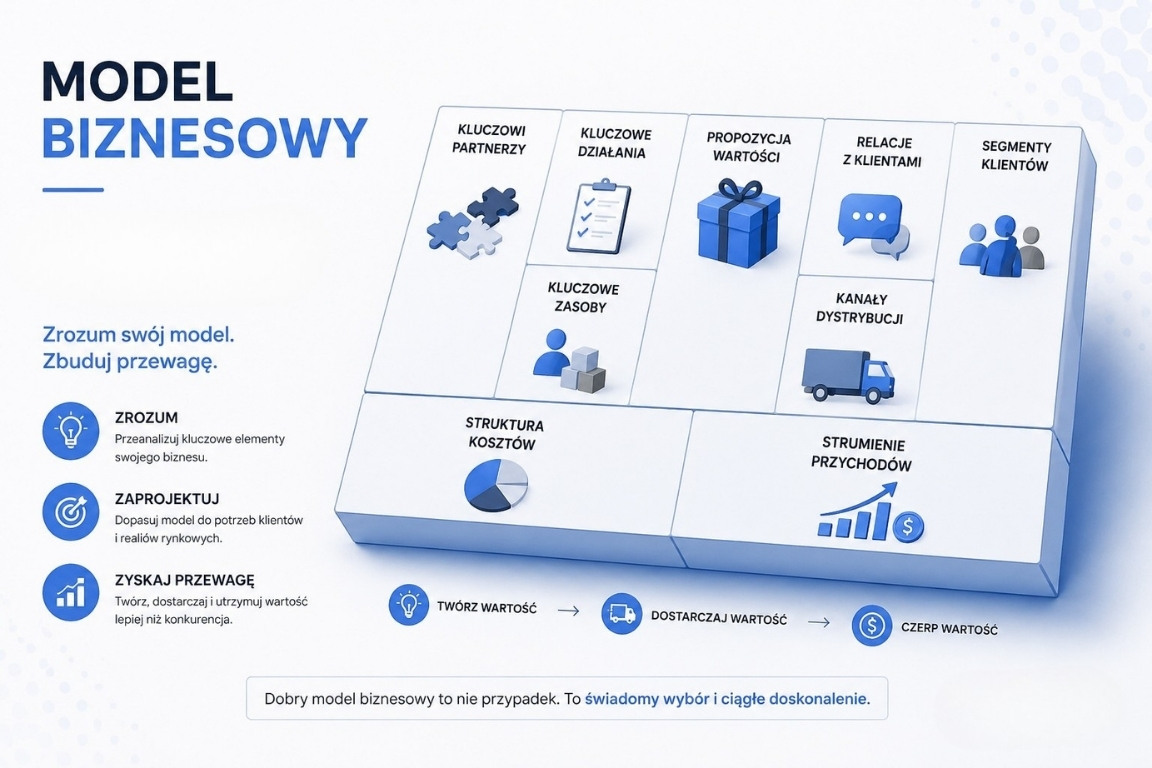
The main premise of the business model template is dividing the model of a typical company into nine main areas. Most ventures can be fitted into exactly such a structure.
Elements of the business model in the Business Model Canvas layout. The numbers are the order in which the template is usually filled in: from customers and value, through channels and revenue, to resources, partners and costs.
The individual areas have dependencies on each other. For a business model to be considered to work correctly, they must work together and ultimately enable the organization to generate profits or other value the organization cares about (for example a large number of new users despite a lack of profitability, because the company’s strategy may be to first acquire a client base and only later monetize it).
The individual elements of the business model according to the Business Model Canvas are, in turn:
Value Proposition
The value proposition is the way the organization solves clients’ problems and satisfies their needs. Most often it is a set of products and services generating value for individual customer segments. It is the set of reasons why clients choose a given company’s offer over the competition’s. A well-defined value proposition for the client is one of the foundations of every company. The lack of something clients want to pay for will not let the company survive in the longer term. Likewise when the promise is not delivered as originally promised: clients will turn away and the company will lose the ability to get money from the market. In B2B technology and service companies, the value proposition is easiest to arrange in the order: the client’s problem, the result, and only then the solution. I describe this in the article on the Value Triangle.
Customer segments
Customer segments are the different groups of people or organizations the company wants to reach with its value proposition. Without clients, and consequently without money from the market, a company is unable to survive in the longer term. You can rely on investment capital, credit or other initial financing, but ultimately every company needs to define the clients for whom its value proposition is a perfect fit for their needs and solves specific problems. To secure an inflow of new clients, over time you need to develop a repeatable and scalable sales processthat will enable you to systematically reach clients with value and win them effectively.
Communication channels
Communication channels describe how the company communicates with the individual customer segments and how it conveys information about its value proposition to them. Channels can be your own (e.g. salespeople, social media, an online store) or external (e.g. partners, distributors).
The choice of communication channels decides whether clients will find out at all that our company exists and has something on offer. Without this it will not be possible to establish a relationship and close a sale. You also need to analyze which channels will be most suitable for our potential clients. As a rule we should operate through those channels in which our audience is reachable. Proper market segmentation will therefore be essential in order to choose the means well and conduct optimal communication.
Customer relationships
Customer relationships are the characteristics of the relationships that connect the company with the representatives of a specific customer segment. The company should be fully aware of what relationships it wants to build with its clients. More importantly, what relationships with the company the clients themselves want to maintain. Depending on the business goal set, the relationships may range from very personal (e.g. when we have business consultingin our offer) to fully automated (an e-commerce store or a B2B purchasing platform).
Key resources
Key resources are the element of the business model that defines the most important resources we need to effectively execute the model. These resources make it possible to produce the value proposition adopted by the company, reach customer segments through the individual channels or maintain relationships with clients. Without specific resources the organization’s operation will simply not be possible. Example resources may be the team, means of production, working capital or domain know-how.
Key activities
Key activities are specific activities in the organization that must take place for the business model to function efficiently. Every company needs to carry out a minimum of specific processes for it to be possible to generate the value proposition (products must be produced, services provided, contacts with clients maintained). Like key resources, key activities simply have to be performed. The word “key” is important here. We often encounter in companies many processes that could really not exist, because they do not deliver value to clients, yet for some reason the organization’s resources are still wasted on them (read the post 8 types of waste). Ask yourself without what your business model will still work.
Key partners
In our definition, ideal key partners are those who share goals with us but are not our cost. More often, however, we deal with partners in the form of the company’s associates (subcontractors), component suppliers (factories) or friendly companies with which we have strategic partnerships helping in the joint development of the business. An example from a workshop: I make tables, you make chairs, so we combine the offer to lower the cost of reaching clients and at the same time serve them more comprehensively.
Cost structure
Every company, wanting to deliver its value proposition and set the business model in motion, incurs the costs of such activity. In particular, maintaining key resources and carrying out key activities usually constitute the main cost centers. The cost structure is therefore a natural element of business models. It also matters what part of the costs is fixed and what part variable, because that determines how long the company will hold out when one project ends and the next one is not there yet.
Revenue streams
For a company to generate profits, the individual customer segments must be profitable enough for revenue minus costs to provide a financial surplus. That is why attention must be paid to those clients to whom it is possible to sell at a high margin. Revenue streams are also the answer to the question of whether you earn one-off, recurring (subscription, retainer, service plan) or commission-based. The method of billing determines the predictability of revenue and whether the model can be scaled at all.
The nine components described above are the elements of the business model. You have to think of them as communicating vessels, because companies often overvalue the importance of the product or service itself. Only all the elements together give holistic knowledge about the functioning of the business and the health of the enterprise.
Example business model: template and description of a B2B service company’s business model
This is what a filled-in business model template looks like. Each area is a field for sticky notes that can be moved, changed and thrown away:

And this is what a simplified example of the business model of a software house of a dozen or so people might look like after a rebuild: from a company that “does everything for everyone” to a specialized company. It is an illustration, not a ready-made pattern to copy. Every company has its own answers in these nine fields.
| Business model element | Example business model (software house) |
| Customer segments | Manufacturing companies in Poland employing 100 to 500 people that have a logistics department and use an outdated warehouse management system. Decision-maker: the COO. |
| Value proposition | Shortening order picking time and reducing warehouse errors thanks to a dedicated WMS, implemented in 12 weeks according to a repeatable process. |
| Communication channels | Outbound to the selected segment, industry content on the website and LinkedIn, referrals from existing clients, participation in two industry trade fairs a year. |
| Customer relationships | An implementation manager on the company’s side, quarterly reviews of results, ongoing contact as part of maintenance. |
| Revenue streams | Implementation billed per scope (not per hour), a monthly subscription for maintenance and development, additional modules sold as products. |
| Key resources | A team with experience in logistics, own reusable system modules, a knowledge base from previous implementations, an expert brand in a narrow niche. |
| Key activities | Pre-implementation analysis, product development, implementations according to a process, sales according to a process, maintenance. |
| Key partners | A supplier of warehouse equipment (scanners, terminals), an ERP integration company, subcontractors for peak loads. |
| Cost structure | Mainly team salaries (fixed cost), licenses and infrastructure, marketing and sales costs; subcontractors as a variable cost. |
How to write a description of the business model in a few sentences
Once the template is filled in, the description of the company’s business model should fit in one paragraph. If you cannot tell it in a couple of minutes in such a way that the other person really understands it, you probably do not have clarity about it yourself. For the example above the description could read:
“We help medium-sized manufacturing companies shorten order picking time and eliminate warehouse errors. We do this by implementing, in 12 weeks, a dedicated WMS based on our own modules. We win clients through outbound to a narrowly defined segment and referrals. We earn on the implementation billed per scope and on a monthly subscription for maintenance and development, which over time becomes the main source of revenue.”
A description constructed this way answers four questions: for whom, what problem we solve, how we reach clients and what we earn on. You can do the same exercise for your company. If the description comes out murky, it is a signal that the model is murky.
Business model analysis step by step
The Business Model Canvas is a tool that lets you organize and analyze the business model literally on one page. It is a map of the logical connections between the most important elements of the company. It helps you see how you really earn and deliver value.
When I run a workshop in person, I print the template in a one by one and a half meter format. It is the optimal size, which allows you to attach the sheet to a large magnetic board or a wall and fill it in with ordinary colored sticky notes. Working this way gives great dynamics, because ultimately everything is just a sticky note that can be changed, moved to another place or thrown in the bin. The business model, or the changes you plan in it, must add up on paper first, before you start spending money on testing and changes in the real world.
Business model analysis is a loop, not a one-off exercise. Once a quarter or every six months is a reasonable minimum.
1. Start with the current state. Draw your current model, preferably on a board or a large sheet of paper. Do not strain for grandiosity. Illustrate things as they really are, not as you would like them to look.
2. Do it as a team. If you have employees, work together. It is a great integrating and educating exercise. It is good when representatives of different areas of the company take part in the modeling. It happened to me once that an accountant who for the first few hours hardly engaged in work on the model at some point came out with something that changed the way the company operated.
3. Mark the places that raise doubts. Where do you have gaps, overloads, inconsistencies? Which segment does not fit the value proposition? Which channel costs more than it brings in?
4. Look for alternatives. What if you change the channel? What if you simplify the offer? What if you change the target group? What if you get rid of one of the key resources or buy it on the market instead of maintaining it?
5. Iterate. Formulate hypotheses, challenge the status quo, test new ideas in small steps. A change of business model rarely happens overnight. It is usually a process of successive iterations. Sometimes, however, even a small change in the model brings spectacular results.
6. Review the model cyclically. No business model is given once and for all. The environment, the market, technologies and client expectations change. If you sleep through the change, the competition can easily overtake you. Once a quarter or every six months is a reasonable minimum.
When you fill in the template, you see in black and white what you have, what you do not have and what is unclear. Many business owners remain stuck for years in an ineffective model because they lack the time, the distance, and sometimes the energy and courage to confront reality. That is exactly why at TechMine we start cooperation with understanding the situation, workshops and conversation. Often one workshop day is enough for a light to come on: things do not have to look in your company the way they do.
Business model self-diagnosis: 10 questions worth asking yourself
Before you get down to the template, I invite you to a short exercise. Ask yourself the questions below honestly, preferably out loud. Some may be uncomfortable, others may trigger new reflections. Each of them is a signal that it is worth looking at the business model from a new perspective.
- Do I know exactly who my ideal client is? Can I describe them in a few sentences? Do I know what frustrates them, what they are looking for, what they fear, what is really important to them?
- Is my offer specific and easy to understand? Does the client know exactly what they are getting? Do they immediately know why it is worth buying from me and not elsewhere?
- Do I know what my company earns the most on, and what only “fills time”? Which products or services generate the greatest profit? Is there something we do only because “we have always done it”?
- Do I have a repeatable process for winning clients? Do I know where the leads come from? Do I have a sales system, or do I improvise every time?
- Do I know why clients come back, or why they do not? Do I have mechanisms that build loyalty, or do clients buy once and then disappear?
- Does my model allow me to scale the company without overburdening me as the owner? Am I able to delegate, or does everything fall apart without my presence?
- Does the company earn adequately to the effort I put into it? Does how much I work translate into real, healthy profit, or rather into fatigue and burnout?
- Does my team understand what we do, for whom and why? Are we all pulling in the same direction, or is it only me who has the whole company “in my head”?
- Am I able to describe my business model in a couple of minutes so that the other person really understands it? Can I draw it?
- Does what I do today give me a chance for a better tomorrow? Does the current model limit me or develop me?
If doubts appeared at several questions, it is a good moment to move on to the practical part: writing out the model and working on it iteratively.
What does working with the business model make possible?
I am strongly convinced that sometimes even a minor change in the business model can bring spectacular results. In the individual areas of the model you can look for room for optimization and improvement. In particular, when the company needs new results (increasing profits, entering new markets, overcoming strong competition), work on the business model is an excellent starting point for deriving new value. You can consider implementing innovations and test business hypotheses in a safe environment. The template can also be used to generate new concepts. It is sometimes the foundation on which the company’s new sales strategy is based.
It is also a tool that creates a shared base of concepts for working on the strategic areas of the company. It can be a source of information about the role of individual people in the organization and provide essential information about how it functions. It makes it possible to analyze the competition and draw conclusions about the chances of market success even before implementing a solution or changing the way the company operates. A well-thought-out model is also the place where a scalable competitive advantage of the companyis born: reusable components, narrow specialization, a repeatable process, and not just “a close-knit team and many years of experience”.
In your organization, if its structure allows it, you can also create a portfolio of business models. You can start with one product or service and over time develop more models. The business models adopted usually determine the success or failure of the enterprise. So it is worth making the effort to create them consciously.
The most common problems in the business models of B2B service companies
Working with software houses, agencies and implementation companies, I most often come across the same set of problems. I have described the full list of sixteen of them, with examples, in a separate article, 16 business model mistakes. Here only those that appear in almost every company I start working with:
- No clearly defined target group. “Our offer is for everyone” means it reaches nobody in particular. Without precise segmentation it is impossible to conduct effective marketing or sales communication.
- An offer that is too broad and scattered. The company offers everything it has ever had the chance to do. Meanwhile one or two lines of solutions often generate as much as 80% of profits.
- No unique value proposition. Mythical quality, many years of experience, flexibility and “a close-knit young team that treats clients’ projects like its own”. How many times have you heard that?
- Billing for time, not for results. Selling time, you will increase scale only together with costs. Consider productizing at least some of the services.
- Dependence on the owner. The whole model is based on the competencies, knowledge or relationships of one person. If this is your situation, consider whether in 10 years you will still feel like working as intensively as you do now.
- Basing the model on one or two clients or one industry. If one client generates more than 15 to 20% of revenue, you are walking a thin, even if for now profitable, line.
- No systematic client retention. Clients buy once and disappear, and every month starts from zero, because the model has no retainers, subscriptions or upselling.
These are only some of the typical problems. In every company they may be more specific and require more detailed analysis. All sixteen, together with a self-diagnosis tool, can be found in the free ebook (in Polish) available on the Polish version of this article.
Examples of companies that changed their business model and grew
Limitations whose source lies in the business model affect even the largest and most recognizable brands. The market does not sleep; the environment and client requirements change. The examples below show that changing even one of the nine areas of the model can change the whole company. These are stories you can draw inspiration from regardless of whether you run a software house, a language school, a creative agency or a manufacturing company.
| Company | Model before the change | Model after the change | Which area of the model changed |
| Netflix | An online DVD rental service, a fee for each copy rented, physical logistics. | Streaming and subscription: one monthly fee, unlimited access. | Revenue streams, channels, key resources. |
| Adobe | One-off sales of boxed licenses for thousands of dollars. | Creative Cloud: a subscription for tens per month, always up-to-date versions. | Revenue streams, customer relationships. |
| Zappos | An ordinary online shoe store. | A brand built around extreme customer service: free returns, lightning-fast delivery, round-the-clock support. | Customer relationships (one area was enough). |
| Apple | A computer manufacturer, later also of phones. | An ecosystem: hardware, software and services (App Store, iCloud, music, video) that draws clients in for years. | Value proposition, revenue streams, partners. |
| Shopify | One of many tools for setting up simple online stores. | The infrastructure of all of e-commerce: payments, logistics, POS, B2B sales tools. | Value proposition, partners, revenue streams. |
| Notion | A simple note-taking tool. | An “all-in-one” platform with a freemium model and paid plans for teams. | Value proposition, revenue streams. |
| Red Bull | An energy drink manufacturer. | A media and lifestyle brand: its own competitions, video content, themed channels. | Channels, customer relationships, key activities. |
| Patreon | A simple tool for accepting payments. | A subscription model in which fans regularly support creators in exchange for additional content. | Revenue streams, customer relationships. |
| Airbnb, Uber | The hotel and taxi industries, operating for decades according to one pattern. | Platforms without their own properties or cars, which became some of the largest operators in the world. | Key resources, partners, channels. |
Each of these companies had the courage to admit: our current model worked, but it will not be enough for the future. And they changed it to better respond to clients’ real needs. The result was scalability, predictability and greater company value. If you think that in your industry the cards have already been dealt, recall what a revolution it was in an industry as traditional as hotels when a platform entered that did not have a single room of its own.
In which direction are business models changing?
Looking at companies that have undergone a business model transformation, clear patterns are visible. The industries differ, from technology, through retail, to services, but the directions of change have many points in common. It is precisely these elements that are most often used today in designing business models that are meant to be more scalable, predictable and resilient to market changes.
The most common directions of change in business models. Most of them concern revenue streams and channels, i.e. how the company earns and how it reaches clients.
Changing revenue streams from one-off transactions to subscriptions, service plans, packages or fees for features. Even car manufacturers are trying to introduce subscriptions for selected car features. It is controversial, but it shows how actively companies are looking for ways to earn recurringly, not just on one-off sales.
Changing distribution channels, i.e. moving from physical points of sale to e-commerce, mobile apps and digital platforms. Online business models (subscription, freemium, marketplace, SaaS) are today the most frequently copied patterns, also by companies that previously had nothing to do with the Internet.
Building a platform or ecosystem. Adding partnerships, integrations, a marketplace, or extending the role of a single product to an entire business environment.
Transforming a service into a product or experience. The client buys not only a thing, but access, a lifestyle, a result or participation in a community. In B2B service companies this is most often productization: a closed scope, a fixed price, a repeatable process instead of billing hours.
Changing the customer segment. Moving from B2C to B2B or from the local to the global market. Some solutions do not make money in retail, but are a good business in wholesale.
Digital transformation. Digitalization and automation of processes, digital customer service, moving away from the need to own physical resources. There are also huge opportunities in monetizing the data you hold and in a personalized but automated customer experience. In B2B trading platforms there is still a multitude of functionalities to be implemented that have been working in B2C for years.
If you consider such changes, you can help your company avoid the problems that most often hold back growth: no recurring revenue, no client loyalty, dependence on intermediaries, low margins and high operating costs, a mismatch with changing client expectations, and limited scaling possibilities. An effective change of business model is not a matter of a trend, but of a strategic decision that results from a deep understanding of your own client, your own advantage and your growth potential.
The 15 most common myths about the business model
Before you start changing the model, pause for a moment on the false beliefs that keep many entrepreneurs stuck. These are myths that sound logical but lead to bad decisions.
1. “Good quality will speak for itself.”
Today quality is not enough. The client must first understand the value. They must know about your existence, trust you and understand that what you offer is for them. This requires a business model that makes it possible: marketing, communication, a sales process.
2. “We need to have a broad offer to serve everyone who comes to us.”
As a result the message gets diluted, resources are scattered, and the client does not know who you really are. Narrow specialization often gives higher profits and a stronger position. You can hear more about this in episode 11 of the podcast “Droga Przedsiebiorcy” entitled “How to sell more by doing less” (in Polish).
3. “The most important thing is to have a good product.”
Your solution is only an element of the business model. If you do not know whom it is for, how you will deliver it, what distinguishes it and how you will sell it, then you have at most a nice concept, and not necessarily a profitable company.
4. “I have it all in my head, I do not need written, formalized models.”
Without a model on paper, your ability to delegate, teach the team, optimize and generally grow is limited. From there it is a short road to being a one-man army without whom the company does not work.
5. “Only a low price convinces the client.”
That is what people say who do not know what modern selling is today and what a difference it can make. They often have clients, but they do not have good sales. Such a belief is a business dead end. There will always be someone cheaper, and clients take more things into account than just the price, even if they claim it is the main criterion. You have to be able to diagnose this and then communicate it. As Warren Buffett says: “Price is what you pay. Value is what you get”. Your business model must understand, communicate and deliver that value.
6. “My model worked 5 years ago, it is proven, so it will work now too.”
The market is changing. Clients are changing. Technologies are changing. What once worked may today be unnecessary ballast dragging your company down.
7. “More clients means more profit.”
Not always. If the model does not scale healthily, more clients means more work, stress and losses. Sometimes fewer clients, but better served, can mean more profit. I know cases of companies in which, despite exponential growth in sales of one product line, the whole company went underwater.
8. “The business model is something you do at the start of the company.”
Definitely not. The model needs to be reviewed, updated and adapted to the successive stages of growth. Just as you change the tools you use every day, you can also change the elements of your business model.
9. “I have to be available to every client, at any time.”
This myth leads to burnout and ruins the possibility of scaling. Your model should contain boundaries: schedules, service levels, customer segmentation.
10. “I cannot limit the offer, because I will lose clients.”
In reality an offer that is too broad confuses clients and makes selling harder. Clear positioning increases trust and conversion.
11. “I do not need a strategy, because the market will show what it wants by itself.”
Strategy is not reading tea leaves. It is a conscious choice of what to do and what not to do. No strategy means drifting and acting reactively.
12. “We operate locally, so the business model does not apply to us.”
The business model applies everywhere, regardless of scale. Even a local car repair shop operates according to some model. The question is whether an effective one.
13. “I will hire more people and that will solve the problems.”
Without a healthy model, more people will most likely mean more chaos. Scaling problems is not growth. First you have to understand what is really not working. The same goes for the much-discussed possibilities of automation today: if you automate chaos, it will still be chaos, only at a larger scale.
14. “In my industry there is no other way.”
I have heard this many times, and it is a rather dangerous assumption. Often it is not the industry but the way of thinking that is the barrier. That is exactly why companies from the same sectors can operate completely differently and win.
15. “The model is something I have to perfect before launching.”
In reality effective models are created in successive iterations. An imperfect but working model is better than a perfect one you never implement.
A company’s business model: frequently asked questions
What is a company’s business model, in the simplest terms?
It is a description of how the company creates value for clients, how it delivers it and how it earns money on it. It answers the questions: for whom, what, how, through which channels, with what resources, at what costs and from what revenue. If you can answer them in one paragraph, you have a description of your business model.
What are the elements of a business model?
According to the Business Model Canvas there are nine: customer segments, value proposition, communication channels, customer relationships, revenue streams, key resources, key activities, key partners and cost structure. They are communicating vessels: a change in one entails changes in the others.
How does a business model differ from a business strategy and from a business plan?
The business model describes how the company operates and earns money today. The business strategy is the choice of where the company is heading and what it will not do, i.e. the direction of changes in the model. The business plan is a document that writes out the model and strategy in numbers and over time, usually for financing purposes. The model fits on one page, the business plan on several dozen.
How to analyze the business model in a small company?
Draw the current model on the Business Model Canvas template, preferably as a team and on a large sheet with sticky notes. Mark the gaps and inconsistencies, test alternatives (a different segment, a narrower offer, a different billing method), choose one or two changes to test on the living organism, and come back to the template in a quarter. One workshop day is usually enough to see what needs to change.
How often does the business model need to be reviewed?
Once a quarter or every six months is a reasonable minimum. The model is not something you do at the start of the company and put in a drawer. The market, clients and technology change, and companies that sleep through the change let themselves be overtaken by competitors who had the courage to admit that the old model had stopped being enough.
Is the Business Model Canvas suitable for a B2B service company, for example a software house?
Yes, and particularly well, because service companies most often have problems precisely in the fields the template highlights: a customer segment that is too broad, billing for time instead of results, no recurring revenue, dependence on the owner. In the example in this article I show what the model of a software house might look like after narrowing its specialization and introducing a subscription.
Where to start changing the business model when the company is not growing?
With an honest drawing of the current state and answering the ten self-diagnosis questions from this article. Most often the first change concerns the customer segment and the offer (narrowing), and the second the billing method (from hours to scope or subscription). Only on such a foundation does building a sales system make sense, because without a well-fitted model more leads only means more chaos.
Will your business model take you where you want to be in 3 years?
Consider whether your business model makes sense. Whether what you do today has a chance of working in a few years. Whether clients really understand you. Whether you know whom you are for. And whether your company works for you, or you for it.
If you are not sure, at TechMine we help B2B technology and service companies design business models that work today and in the future, and then build a sales system on them. We start with a conversation and a workshop, without pressure. Book a free consultation or read what B2B sales consulting and the SalesMachine system.
| You can listen to the whole episode on the business model here (in Polish): #24 Droga Przedsiebiorcy: “Does your business model make sense? Or why some companies grow and others do not” |