Knowledge

Business strategy: worth talking about
Business strategy
The topic of another meeting of entrepreneurs was business strategy and the challenges of implementing it operationally in the daily functioning and organization of a company.
What a business strategy is
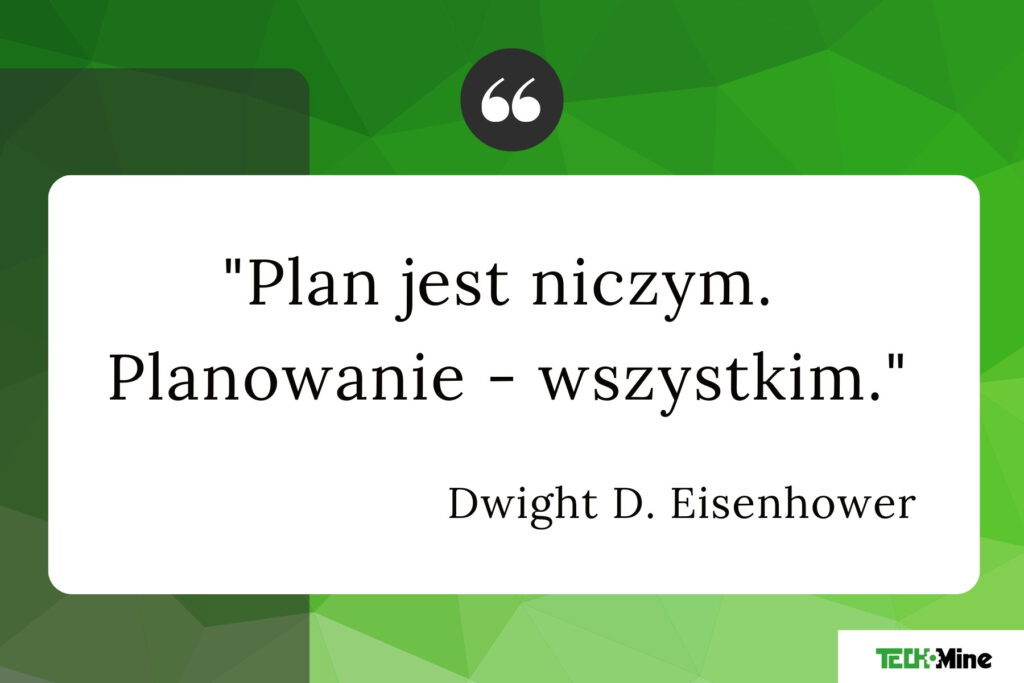
By the concept of strategy, in a small or medium-sized company, we rather mean a concise definition of the sense and purpose of the organization’s existence, not a voluminous strategic document that is sometimes prepared by an external consulting firm. A strategy for an SME should be a few pages long and stained with coffee, which indicates that someone looks at it. A good strategy is the result of planning, which reminded those gathered of the quote attributed to Eisenhower: plans are nothing; planning is everything. In an era of rapidly changing market circumstances, the goals that result from the strategy, operational goals and financial goals should be constantly monitored, and the strategy should be continuously subjected to constructive criticism. Important for the owner or management of the company is reflection on its future and the methods of fruitfully securing it. Strategy meetings should take place away from current activities, preferably outside the headquarters and office, in a narrow circle of people who will later supervise its implementation. They should not be time-limited in advance, and no other activities should be planned on the day of such a meeting. It is important not to create the strategy single-handedly; a partner, a financial director or an external business advisorwill be helpful. Good concepts are born between heads, critical verification of the concept is important, but the participation of too many people in such a meeting does not favor the clarity of the vision. And the company vision should stand above the company’s strategy.
The strategy document should take market dynamics into account
The strategy should not be set in stone either. Market circumstances change, consumer moods fluctuate, new technologies appear, new business models displace the older ones. Blindly following and forcibly pushing through the adopted strategy can lead to the perfect execution of a poor plan. So it is worth constantly keeping a finger on the market’s pulse and supporting dynamic ways of managing to ensure the possibility of continuous development and improvement.
Once a strategy has been adopted, apart from proactive actions, “pruning dry branches” is also important. Companies generally develop organically; it happens that the activity that gave the company its start becomes over time a minority activity, or less profitable than others. Often, for sentimental or personal reasons, such an activity is maintained. Meanwhile, if it clearly does not fit into the company’s strategy, it should be phased out, even with a heavy heart.

Implementing the business strategy
Implementing the strategy does not exclude looking for areas of activity not included in it. One should always look for new opportunities; it is important that they do not cause a fundamental change in the company’s DNA without a conscious decision on the matter. Uniformity of activities serves small and medium-sized enterprises. If something very promising is found, the strategy should be rethought. In any case, the strategy should be reworked cyclically; there is no strategy for eternity, and in the present era, given the variability of the environment, its validity is becoming shorter and shorter. One of the key areas of strategic consideration should be your business model, which is the central place of business strategy.
Do you need support in developing your company’s strategy? Do you see a need to improve your business model? Contact us, and let’s talk with no obligation.
During the entrepreneurs’ discussion, a question was also asked about obstacles to implementing the strategy. Those gathered stated that there are infinitely many such obstacles, but they must be dealt with, and a clear strategy makes it possible to choose the methods of dealing with them. Problems with employees were considered an important obstacle. Recently people’s approach to work has changed significantly; the entrepreneur is forced to negotiate the conditions and outcome of work rather than being able to give and enforce orders. The oldest motivator is of course money, but in creative industries the sense of what they do is of equal importance to employees. Here the strategy is helpful, because it can be a tool for uniting the staff around its implementation. It is worth taking a strategic approach to building and consolidating the right organizational culture, which favors increasing employee effectiveness and achieving the goals set. From a strategic point of view, goals should be inscribed in the long-term vision of the organization’s development.
The whole of strategic management should also take into account the current situation at the given time on the market and in the industry, because the context in which the company operates is key to the proper allocation of resources. Strategic success will be the result of:
- the company vision taking into account all stakeholders
- the process of delivering value to the client being effective and efficient
- management favoring a culture of continuous development
To achieve the above, whether in production or services, the party strategically responsible for the company will have to be able to properly communicate first the vision, then the company’s strategy, at the appropriate level of generality, to all employees, so that the team adopts them as their own. All employees of the company should be aware of the sense and purpose of its operation. Such knowledge allows them to make independent decisions beneficial to the organization. The essential points and values of the strategy should be recalled and repeated to employees as often as possible; on the occasion, management reminds itself of them too. Although the strategy cannot be implemented without employees, the responsibility for its implementation rests mainly not with them, but with the company’s management. It is the management that, among other things through clear communication of the company’s goals and principles, will be held accountable for implementing the company’s strategy. Business success, growth, achieving strategic goals for products and the brand, and outpacing the competition will be, as is customary in Poland, “everyone’s work”, whereas all failures and deviations from the plan you can, as the owner or management, immediately attribute exclusively to yourself.
The owner’s strategic influence
An issue of an ethical and philosophical nature also came up: to what extent is the company’s strategy a derivative of the personality of the owner or the company’s main manager. The smaller the organization, the more so, but as the company grows it becomes necessary to take into account the point of view and principles observed by others, because hardly any success is the work of one person alone.