Knowledge


How to scale a service company
Scaling a company means arranging sales, service delivery and management so that revenue can grow faster than costs and the owner’s workload. To scale a company, you first need to know who the ideal client is, then build a repeatable sales process, describe the operational processes, base decisions on numbers and gradually transfer responsibility from the owner to the team, while keeping an eye on the margin, because it finances every next step and enables company growth.
So much for theory, and now about what it looks like from the inside. The moment when a company has a few or a dozen employees can be exceptionally hard, although from the outside everything looks fine: clients come, projects happen, there is money in the account. The owner works a lot, often more than ever before, and yet feels that further growth no longer comes as naturally as at the beginning. Fatigue appears, sometimes frustration, and that one question that comes back in the evenings: why, when I put more and more energy into the company, does it not grow more?
If this sounds familiar, you are in the right place. In this text I have combined what the companies I support face, i.e. technology companies and small B2B service companies, with what I have been through myself, building and co-founding my own ventures. You will find here the answer to why a small company stops growing, what scaling is and where to start it in your organization, in an order that makes sense.
What scaling a company is and how it differs from ordinary growth
Growth and scaling are often lumped together, although they describe two completely different situations. A company grows when revenue goes up, but along with it, at a similar pace, costs grow, the number of people and the number of hours the owner spends at work, so every next client means roughly the same additional effort as the previous one. Scaling begins when this relationship loosens, and the company can serve twice as many clients without doubling costs, generating chaos and requiring ever more of your involvement.
In the end it all comes down to three things that must work at the same time: winning better clients, serving them in a repeatable, process-driven way, and maintaining a high margin. The answer sounds simple, but implementing it is a completely different story, because it touches sales, marketing, the way value is delivered and, which is often the hardest, the role of the owner themselves.
When is a company ready to scale?
Before you start accelerating, it is good to check whether there is anything to accelerate. Scaling amplifies what already works, but it also amplifies every mistake, so a company with an unprofitable service or random sales simply loses money faster once the scale increases. Readiness is usually indicated by signals like these:
- you have a group of clients who come back, recommend you further and pay without long negotiations,
- you know your real margin on your main services or products, not just the overall balance in the account,
- you know where clients come from and can say how much it costs you to win one of them,
- you feel that demand is there, and the brake is the company’s capacity and your availability,
- at least part of the work can be described so that someone else can do it without your involvement.
If most of these points are question marks for now, do not be discouraged, because scaling starts precisely with putting them in order, as discussed further on.
Why a small company stops growing and what blocks scaling
The problem of small companies very rarely lies in a lack of clients or a bad market. Much more often it is that the company simply was not built for growth, and the barriers that stop it are surprisingly similar regardless of industry.
The owner becomes the bottleneck
This is the first and usually the least visible barrier. At the beginning everything works precisely because it is you who sells best, knows the clients, knows how to solve problems and has the most experience. The trouble comes later, when the company stops being a small team, and every decision, every problem and every important conversation still comes back to your desk, so the company can grow exactly as long as your time and energy last. Until you start consciously handing over decisions and responsibility, you will remain the busiest employee of your own company instead of being its architect.
Sales based on referrals and chance
In small companies sales usually rest on referrals and networking: someone finds the company by chance, someone calls, someone comes via a friend. With a few new clients a month that is enough, but at a larger scale such an approach will not keep the machine running, because it is hard to predict anything. When the sales process is not described, repeatable or measurable, it cannot be handed over to others, so the owner hesitates before hiring a salesperson, unsure whether they can provide a steady stream of work, and the company stands still, although it could grow much faster.
Last-minute recruitment
The decision to hire is usually made too late, when the owner is already overwhelmed with tasks and looking for anyone who will take some of the load off. In such a hurry there is no clearly defined role, scope of responsibility or expectations, and the new person has no chance of proper onboarding. After a few months the sentence “nobody will do it as well as I do” is spoken, although the problem rarely lies with the employee and almost always in the lack of a system, processes and procedures that the employee could step into.
No decision-making structure
With a few people, decisions made intuitively and ad hoc somehow hold up. With a dozen or more, chaos begins, because people do not know who is responsible for what, decisions are delayed, and you are flooded with questions that should never reach you at all. Without a clear division of responsibility and simple rules for making decisions, the company starts to choke on its own pace of growth.
Knowledge in people’s heads
Everyone does things their own way, everyone has their own way of working, and when someone is missing, the owner fills the gap. In a small team this can be controlled, whereas in a growing company the lack of processes translates into mistakes, delays and conflicts, and worse, the owner often looks for culprits among people, while the source of the trouble is undescribed rules of operation.
Decisions without numbers
I have known many entrepreneurs who ran their company looking mainly at the account balance and guided by the general impression that “things are fine”. When scaling, that is not enough, because you have to know how much it costs to acquire a client, what the real margin on a service is, where the money leaks out and which activities really pay off and which only generate work. Without these numbers every growth decision rests on hope, and hope is a poor strategy when hiring more people.
The foundations of scaling a business: client, offer, margin and trust
Before you start recruiting, buying tools or increasing the marketing budget, you need a foundation on which all of this will rest. Without it, each of these investments will more likely just enlarge the mess.
Who a good client is and why scaling starts with them
A good client is a company or person whose needs really fit your offer and who is willing to pay enough for you to cover costs, invest in growth and keep the margin you care about. It is also a loyal client, who comes back and leaves money in your company regularly, not once every few years. That is why, from the point of view of scaling, it is better to sell higher-value solutions or recurring services that give predictability of revenue than to chase one-off transactions.
It is easy to see this on the example of a company building applications. It can sell a product once and start every month from zero, or it can offer licenses, maintenance and further development of the software over the longer term, building a relationship for years. The second model gives a customer lifetime value (LTV) many times higher than the first, and consequently allows you to spend more on acquiring a client and still earn on it. One simple measure helps keep common sense here: comparing the client’s value over the whole period of cooperation with the cost of acquiring them (CAC). If LTV is only slightly higher than CAC, scaling sales will simply be scaling losses.
Narrow specialization instead of a broad offer
At an early stage many companies broaden their offer to fit different clients, and at first it seems reasonable, because every new order is revenue. Over time, however, it turns out that it is hard to deliver all services at a high level and at the same time compete with companies that do only one thing in a given niche. Focusing on a specific specialization helps build unique value, simplifies processes, shortens the onboarding of new people and attracts loyal clients who are looking for an expert, not a jack of all trades.
Productizing services
Even a service company can, and if it wants to scale, should think about “productizing” its offer, i.e. turning bespoke services into packages with a defined scope, course, price and result. Such a service is easier to sell, because the client knows what they are buying, easier to price, because you know its cost, and easier for the team to deliver, because every project does not start with inventing everything from scratch.
Margin instead of competing on price
Price competition is a trap that is hard to get out of, because there will always be someone who offers the same thing cheaper. By lowering the margin, you also take away your fuel for growth, and the faster a company grows, the more resources it needs: for new people, for outsourcing part of the tasks, for marketing, for implementations, for periods when the costs are already there but the new revenue has not yet appeared. Without financial buffers it is hard to survive even well-planned growth, which is why building value and margin is a condition of scaling, not a side effect of it.
Trust as an advantage in the sales process
When the market is full of similar products and services, the client often sees no difference between you and the competition, and then trust decides the choice. Clients do not always buy from those they like, but almost always from those they trust, so your job is to build that trust at every stage of the sale. Communication should be clear, transparent and show the specific value you deliver, and promises are best backed with evidence: described client results, references, a transparent course of cooperation and content that shows you understand the problem before the conversation even takes place.
How to scale a small company step by step
The order below is not accidental, because each step prepares the ground for the next. You can of course act on several fronts at once, but if you skip the foundations and start with hiring or buying tools, it is quite possible that in six months you will be tidying up a bigger mess than the one you started with.
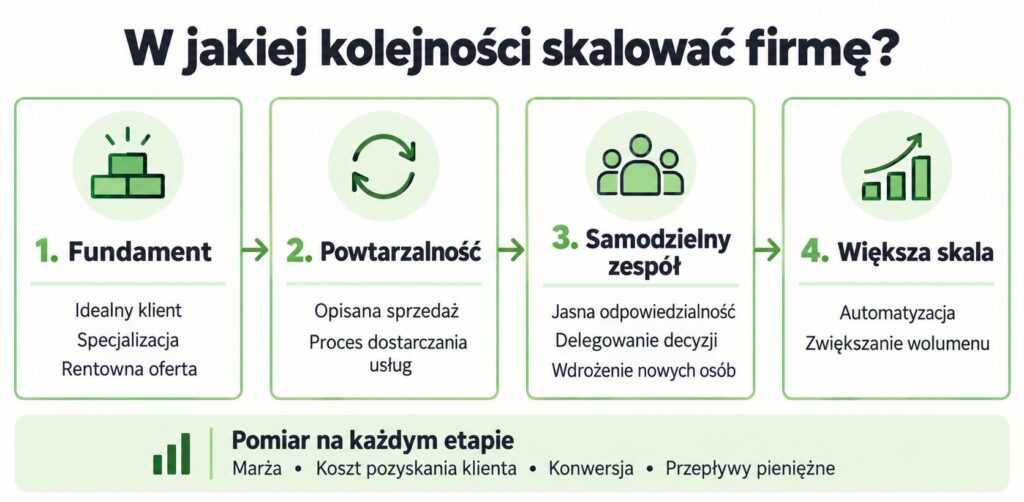
1. Count how much you work in the company and how much on the company
Many owners spend most of their time on current tasks and serving clients, and are left with evenings and weekends for developing the business. Start with simple statistics kept for two or three weeks, in which you record how much time goes on delivering value to clients and how much on strategy, developing the offer, sales and building relationships with key partners. Such a measurement is usually quite sobering, and at the same time gives a starting point for setting a goal, for example shifting the proportion by a few hours a week every quarter. It also helps you look at the company’s current stage of development as a transitional stage, not a target state.
2. Describe the ideal client and narrow the offer
Review the clients from the last two years and pick those you earned best on, worked best with and who came back or recommended someone to you. See what they have in common: industry, size, the problem they came with, the person who made the decision. That is your ideal client profile, and the offer should be fitted precisely to them, even if it means giving up some services that today bring small revenue and a lot of confusion.
3. Build a repeatable sales process
Sales are the first area to turn into a process, because they decide whether the next people on the team will have anything to do. Describe the stages a client goes through from first contact to signing the contract, the criteria by which you recognize that a conversation makes sense, and what happens at each stage and who is responsible for it. Once at least one predictable source of enquiries appears alongside referrals, for example content, advertising campaigns or outbound, and you start measuring conversion between stages, hiring a salesperson stops being a leap in the dark. In the SalesMachine system, which I implement in B2B companies, I base sales building on five pillars: strategy, process, communication, tools and measurement, because only together do they produce sales that do not depend on one person.
4. Turn service delivery into processes
You do not have to create a thick book of procedures right away. Start with the activities that repeat most often or that most often come back to you with the question “how do I do this?” and write them down as a short list of steps, a screen recording or a simple template. Processes and procedures standardize work, which increases efficiency and margin, makes it easier to onboard new people, speeds up bringing a new solution to market, and makes the company less dependent on individual people and more on proven mechanisms of operation.
5. Establish who decides what
Write out the typical decisions in the company and assign them to three groups: those the team makes on its own, those that require consultation, and those you reserve for yourself. Simple thresholds help here, for example the discount amount up to which a salesperson does not have to ask, or the purchase value a project manager approves on their own. Even such a one-page map can take a surprising number of small questions off your mind.
6. Hire earlier and into a described role
Recruitment should start when an approaching overload can be seen, not when it is already underway. Before you publish an ad, describe the role, the scope of responsibility, the metrics by which you will both recognize that the work is going well, and a plan for the first weeks, so that the new person enters a ready system instead of guessing what you expect of them.
7. Run the company on numbers
Choose a few performance indicatorsthat really say something about the company’s condition, and check them every month: client acquisition cost, the real margin on your main services, customer lifetime value, conversion in the sales funnel, the share of recurring revenue in the total, and cash flow a few months ahead. A spreadsheet is enough to begin with; more important than the tool is regularity and actually making decisions based on these numbers.
8. Automate only what already works
A CRM, automations or AI-based tools can speed a company up a lot, but only when it is known which process they are meant to support. Automating chaos produces faster chaos, so choose tools for an already described process, not the other way round.
9. Change your role in the company
This is the hardest element, because it concerns you. When the company grows, you can no longer be the main or the only specialist, so your role shifts towards designing systems, developing people and setting direction. It requires giving up control and accepting that others will do certain things differently, at first often worse, but thanks to that the whole company can grow. Many entrepreneurs stop right here, because subconsciously they fear losing direct influence on quality, and it is hard to blame them, since for years it was their personal involvement that built the company.
The most common mistakes when scaling a company
Most failed attempts at scaling do not come from bad will or laziness, but from good intentions implemented in the wrong order. These are the most frequently repeated:
- hiring before the process is ready, so that new people add questions instead of taking work off your hands,
- lowering prices to win more clients, which eats the margin needed for growth and attracts clients who will leave at the first cheaper offer,
- broadening the offer for every client, which dilutes specialization and complicates delivery,
- investing in marketing without described sales, when enquiries come in but nobody has the time or the way to close them,
- buying tools in the hope that they will tidy things up for us, although a CRM without a process becomes just another contact database,
- decisions based on impressions, without knowledge of margin, client acquisition cost and cash flow,
- keeping all decisions to yourself out of concern for quality, which means the company grows at most to the limit of your capacity.
The good news is that each of these points can be brought under control. There are proven practices, and often just looking at the company from the outside lets you see which element is blocking it the most.
Where to start scaling your company this month
If I had to point to one first move, it would be measurement: for two weeks write down where your time goes, and in parallel calculate the real margin on your three main services and check where your best clients came from. These three answers will show whether you first need to put the offer, sales or your own calendar in order, and the further steps from this guide will fall into a natural order. As long as you treat the company as a set of activities and not as a system, every attempt to speed up will end in fatigue, which is why the sooner you start designing it, the lighter it will be to grow.
If you want to check how mature sales in your company are today, you can use the free online B2B sales diagnosis (in Polish), and if you prefer to talk directly about your situation, book a free consultation.
FAQ: scaling a company
How does scaling a company differ from its growth?
Growth means an increase in revenue, usually accompanied by a proportional increase in costs, headcount and the owner’s work. Scaling is a situation in which revenue grows faster than costs and workload, because the company rests on repeatable processes, a productized offer and a team that operates without the owner’s constant involvement.
Where to start scaling a small company?
With honest measurement: how much time the owner spends on operational work, what the real margin on the main services is, and who the best clients are. On that basis the offer is narrowed, a repeatable sales process is built, and only then are operational processes described and more people hired.
How to scale a service company?
A service company is scaled above all by productizing the offer, i.e. turning bespoke services into packages with a defined scope, course and price, and by moving from one-off orders to recurring cooperation. Thanks to this the service is easier to sell, price and hand over to the team.
Why does the owner block the growth of their own company?
Because in a small company it is usually the owner who sells best, knows the clients and solves problems, so all decisions naturally pass through them. When the company grows, this model means it can grow only to the limit of one person’s time and energy, until the owner hands part of the decisions and responsibility over to the team.
When to hire the first salesperson?
When the sales process is described, you have at least one predictable source of enquiries besides referrals, and you know what conversion looks like at the successive stages. A salesperson hired into undescribed sales usually reproduces the chaos they were meant to put in order.
Can a company be scaled without large investments?
Partly yes, because describing the sales process, narrowing the offer, setting decision rules or keeping indicators in a spreadsheet require mainly the owner’s time. The next stage, i.e. hiring, marketing and tools, already needs money, which is why building margin and financial buffers beforehand is so important.