Knowledge


A sales system in a technology company
B2B sales system: why technology companies do not have one and how it blocks growth
A sales system is the way a B2B technology company approaches client acquisition as an end-to-end business process. It is the organizational architecture that makes selling complex technical solutions predictable, measurable and independent of one person. Most technology companies do not have such a system, because they never consciously designed one. Sales grew organically, through referrals and the owner’s involvement, and as long as that was enough, nobody saw a reason to change anything.
In B2B technology companies the same scenario repeats: sales start to falter, results start to fluctuate, and what worked only recently stops producing effects. The owner feels mounting pressure and a growing conviction that something has to be done, so they look for a salesperson who “understands technology”, change the offer, intensify marketing, invest in training in sales techniques. The problem is that the vast majority of these actions do not touch the real cause, because sales are often not the problem in themselves.
Why sales in B2B technology companies are unpredictable
The unpredictability of sales in a technology company does not stem from the market, the competition or the quality of the product, but from the fact that sales were not designed as a system.
Technology companies have a specific sales dynamic. They sell complex solutions the buyer cannot fully assess before buying, the sales cycle is usually long, the contract high, and the client needs a better understanding of the value before making a decision. Sales in such companies are therefore consultative by nature: the point is to take the client through a process in which they understand that what they are buying will actually solve their problems and why this particular company is the right partner.
At an early stage of a company’s development, this kind of selling works naturally. The owner is close to the market, knows the technology inside out, builds relationships, gets referrals, and clients come because the company is flexible and fast. Decisions are made ad hoc, but that does not get in the way, because the scale is small.
The problem appears the moment the company tries to move beyond that stage. With growth comes complexity: new people on the team, new dependencies, more projects to handle in parallel. What used to be an advantage starts acting as a limitation. The owner, who used to sell alone and did it well, now has no time for sales conversations because they are busier operationally. Referrals still come, but they are no longer enough, because the company has grown and managers have appeared. The salesperson hired to “relieve the owner” does not deliver, because nobody gave them a sales process, a proposal structure or clear criteria. Nobody explained either what a good conversation with a client buying a complex technical solution consists of. The missing element is also often a sales strategy.
Such sales become unpredictable, and for reasons that have nothing to do with the team’s competences or with market changes. The company simply keeps operating as if it were at a stage it is no longer at.
The owner of a technology company who tells themselves “we are managing somehow”, even though the company has made the same revenue for the third year in a row, knows this feeling well. They know something is off, but cannot name what.
What a sales system is not
One of the biggest problems in conversations about sales is that the term “system” is sometimes understood very superficially. For some a sales system is a CRM, for others a process written up in a presentation, for still others a set of call scripts, funnels or automation tools. In reality none of these things is a sales system, because a sales system is not closing techniques, nor communication training, nor a procedure implemented in a tool. All these elements can be part of a system, but none of them creates it on its own.
In a technology company this blurring is particularly costly, because a client lost in the process often means hundreds of thousands or millions of zlotys of lost revenue in the following years. So the owner sends the salesperson to sales techniques training, the salesperson comes back with new arguments, but still does not know how to talk to an IT director about an implementation that will take eight months and cost a six-figure sum. The problem was not in the conversation, but in the fact that the company had no thought-through way of guiding the client through the decision process.
When companies confuse a system with techniques, they start patching symptoms instead of solving causes. They improve arguments, introduce new tools, change proposal presentations, but do not touch the structure that generates the problems. The effect is usually the same: a short-lived improvement, after which everything returns to square one.
What a B2B sales system is in a technology company
A sales system is the company’s operating logic in the area of client acquisition, an architecture that joins strategy, the way decisions are made, the organizational structure and the team’s daily work into one whole.
A real sales system answers the fundamental questions: where clients come from, why they buy, what their decision process looks like, who makes decisions on the company’s side and at which moment, how results are measured and what happens when something stops working.
In a technology company there is one more question on top of that: how to translate expert technical knowledge into a language the buyer will understand and base their decision on. An implementation company or a producer of technical solutions sells something the client usually cannot assess on their own, so the sales system must take this asymmetry of knowledge into account and turn it into an advantage, not a communication barrier.
A well-designed sales system does not depend on one salesperson or one channel. It is designed to work independently of individuals, and that is exactly what distinguishes stable companies from those living from referral to referral, from one big contract to the next. In such a system every decision has its rationale, every stage of the process has a purpose, and every element can be analyzed and improved without turning the rest upside down. Sales stop being improvisation and start to resemble engineering.
Why most technology companies have no sales system
Most technology companies never designed sales as a system, because sales simply happened.
First the owner sold, and did well, because they knew the product better than anyone, understood the technology and could speak the client’s language. Then the company grew, the first salesperson joined, then another, over time marketing appeared, a CRM, campaigns, leads from industry conferences. Each element was added in response to current needs and none was part of a thought-through whole.
Referrals worked well enough to mask what the company really did not have: a repeatable way of reaching new clients. An owner who says “the company works, but everything depends on me” is describing exactly the situation in which sales hold up as long as there are people pulling them along, and stop working when turnover, a market change or a growth ambition appears that the existing model cannot carry.
The lack of a sales system means the company does not know why it sells. It only knows that sometimes it works out, which means it is unable to consciously repeat the result or plan anything with reasonable certainty.
The consequences of having no sales system
The lack of a sales system leads to the same consequences regardless of whether the company develops software, implements ERP systems, integrates cybersecurity solutions or manufactures technical equipment.
Sales lose predictability, results fluctuate for no clear reason, and planning loses its sense, because nobody can reliably forecast revenue for the next quarter. The owner gets ever more involved operationally, joins sales conversations, corrects proposals, supervises every deal personally and over time becomes the bottleneck of the whole organization. In technology companies this effect is particularly strong, because the owner is often the only person who understands the product deeply enough to lead a sales conversation with a demanding technical client.
The team starts to act reactively, responding to situations instead of running a process, putting out fires instead of working to a plan. The salesperson does not know what stage a given deal is at, because nobody defined the stages. The company becomes dependent on single elements: one salesperson, one relationship, one big client, so that every personnel change or lost contract grows into a threat to the whole business. The owner, who is at once salesperson, manager and firefighter, treats this overload as a competitive advantage, although it is a symptom of the company lacking an architecture.
A sales system and scaling a technology company
Scaling is something other than doing more of the same. It is the ability to repeat a result in a controlled way, and without a sales system that ability simply does not exist.
Every attempt to scale a technology company without a sales system ends in disappointment: more clients means more exceptions, more communication problems and more decisions made under pressure, and the owner, instead of gaining breathing room, loses it entirely. With a sales system the company knows which actions lead to the result, which elements of the process are repeatable and which require an individual approach, and can respond to market changes because it understands the mechanism, not just the end effect.
In an implementation company or a technology company selling large enterprise solutions, the sales system is what allows the transition from owner-dependent growth to process-based growth. That transition changes the predictability of the pipeline, the margin, operational calm and the ability to delegate. Growth stops being a risk and becomes a decision.
The owner’s role in building a sales system
Nowhere does a sales system play a greater role than in the context of a technology company’s owner. It is they who decide whether the company will operate in an orderly way or remain a collection of improvisations that hold together only because the owner patches them with themselves.
An owner who does not design the system will always be part of it: they will have to supervise, correct, control and react, and in the longer run this leads to burnout and blocked growth. Turnover may grow, but peace of mind does not grow with it, because the business model was not updated as the organization expanded.
Building a sales system requires a change of perspective: moving from operational decisions to structural ones, from reacting to designing, from being the best salesperson in the company to being the architect of a mechanism that works without the owner’s daily involvement. An owner who makes this change stops selling alone and starts building a company that sells systematically.
How TechMine approaches building a sales system
I have built technology companies myself and I know the sale of complex B2B solutions both to technical clients and to those responsible for the business, with all the project pressure, implementation logic and economics of such a company from the inside. That is why TechMine’s approach starts with understanding how the company works, where decisions are made, what the real constraints are and what actually affects the sales result, not with tools or techniques.
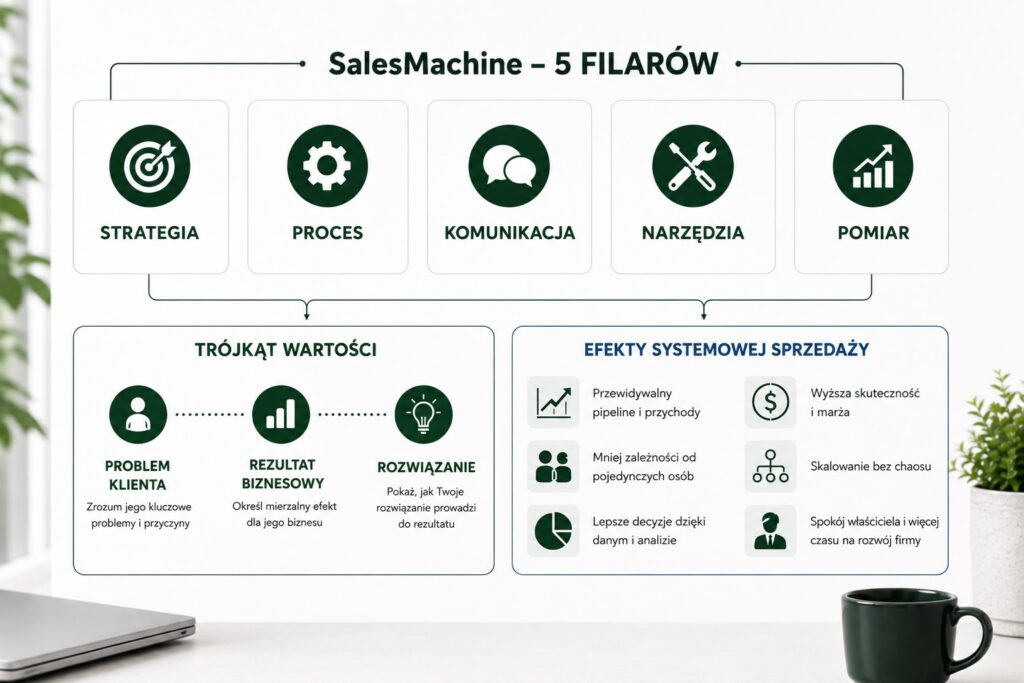
The central element of this approach is SalesMachine: a proprietary framework for building predictable, measurable and scalable B2B sales, made up of five pillars working as one architecture. Strategy describes whom the company sells to and why it in particular should be chosen. Process organizes what happens from first contact to signing the contract. Communication supplies the language, techniques and tactics for the client to become convinced of the value. Tools turn repeatable goals into repeatable actions. And Measurement shows what actually works and what only seems to work.
The second element is the Value Triangle, which organizes the way of thinking about the three layers of consultative selling: the client’s problem, the business result and the solution the company offers. Owners of technology companies too often start the conversation with a story about the technology instead of the problem that technology solves. The Value Triangle reverses this order, which changes the way sales conversations are conducted at the organizational level.
This approach eliminates randomness, makes it possible to understand why something works or does not, and allows sales to scale without losing control of the process and the margin.
Why TechMine distances itself from trick-based selling
Selling based on pressure, manipulation or closing techniques may work in the short term, but in a technology company it destroys what the whole business should be built on: trust. A client buying a system implementation for several hundred thousand zlotys will not make the decision under pressure. They will make it when they understand their real problem and believe the company can solve it.
The same goes for an approach based solely on referrals and networking, which, valuable as it is, cannot be the foundation of growth for a company developing in a predictable way. Referrals work, but they give no control over the pipeline, and a company dependent on a channel it does not control really has limited growth possibilities. It simply has luck, which may one day run out.
TechMine proceeds from the assumption that sales should be the natural effect of a well-designed system, not the result of pressure, improvisation or luck.
A system instead of improvisation
Technology companies that build sales systematically operate differently. They have clear rules for conducting conversations with the client, a coherent process independent of who happens to be running it, a shared language in the team, an awareness of goals and of what they measure and why.
The most important difference is that they stop depending on individual people and build an organization that can sell regardless of whether the owner is involved. That is a concrete change in the way a company selling complex B2B solutions operates.
Summary
A B2B sales system is the foundation on which a company’s ability to grow predictably stands, especially in technology companies, where the complexity of the product, the long sales cycle and the consultative nature of the client relationship mean that improvisation and pressure have a short shelf life. Good sales in a technology company come from a well-designed mechanism combining strategy, process, communication, tools and measurement. That is what SalesMachine is about and what TechMine’s approach rests on.