
Knowledge


Cold mailing in B2B: how to do it well
I am guilty, directly or indirectly, of sending tens of thousands of email sequences, both my own and through my clients. But before you start blaming me for what lands in your inbox, let me quote one of the many replies I have received over the years:
“Hi, since I did not delete it reflexively, I read to the end, and I am terribly sensitive to spam, so I decided I had to reply, to answer for myself what happened that I did not delete it automatically. – short subject in lower case, I thought it was an email from a client or a friend – concise, short, even if it is an automated email it is neatly personalized – then I was intrigued by what you want to sell me, so a quick scan, apparently nothing, so ok, I will read the whole thing So I made it through, hence this email, you can keep sending me more :)”
– CEO of one of the large Polish companies
Over the years I have received many more such messages. People appreciate the way they were addressed, or say with slight regret and recognition that they tried to teach their people to write this way, but without success.
Cold mailing is still one of the most effective methods of opening conversations with new clients, but only when it is done well. And the difference between “well” and “any old how” is enormous.
Why does cold mailing still work?
Many people claim that cold mailing does not work. We are flooded with a huge number of messages that do not make a good impression on us and that we do not want to receive. You may also think that maybe somewhere, in some company, with a specific product it will work, but surely not in your company, not with your specifics. Especially if you sell complex, specialized solutions to large clients, or the recipients are C-level people.
My experience shows otherwise. It is possible to open CEOs and owners of companies with billions in turnover with cold emails. Practically not a week goes by without one of my clients telling me about opening in this way another company that turns over hundreds of millions, and sometimes even billions.
Recently one of my clients wrote to me on a messenger:
“We sent a message to a certain furniture man. It turned out he appears on the list of the richest Poles, but he read the email, forwarded it, and now the manager of the business analysis department from his company has contacted us. We have a meeting on Friday.”
Opening communication with companies of any scale is possible, provided that you treat the sending of the message itself as the culmination of a demanding preparatory process, not as a goal in itself.
How does cold mailing differ from mailing?
The main difference is that in cold mailing activities we contact people who do not know us, and the format of the message is meant to simulate communication from a living person. In standard mailing the recipient has already had some contact with our brand and has consented to receiving messages.
I will not go into legal issues and I refer you to your lawyer. However, if you run cold mailing activities the way I discuss them below, you will almost certainly be on the bright side of the law. And if you do something more loosely, then in the worst case in a grey, defensible zone.
Why do “lead generation” companies usually fail to deliver?
Many people have bad experiences with so-called lead generation companies, which assure you that you basically do not have to do anything: just pay and wait for ready clients. If building prospecting and sales were that simple, practically everyone could be acquiring clients en masse today.
To be fair, sometimes such outsourced activities can bring results, but usually only temporary and unsustainable ones, in simple industries where the products are of the self-explanatory kind.
If, however, you sell specialized, more complex solutions, then without proper preparation I would not expect results. And by deciding to outsource it, you risk not only the reputation of your domain, but of your company.
Three pillars of effective cold mailing
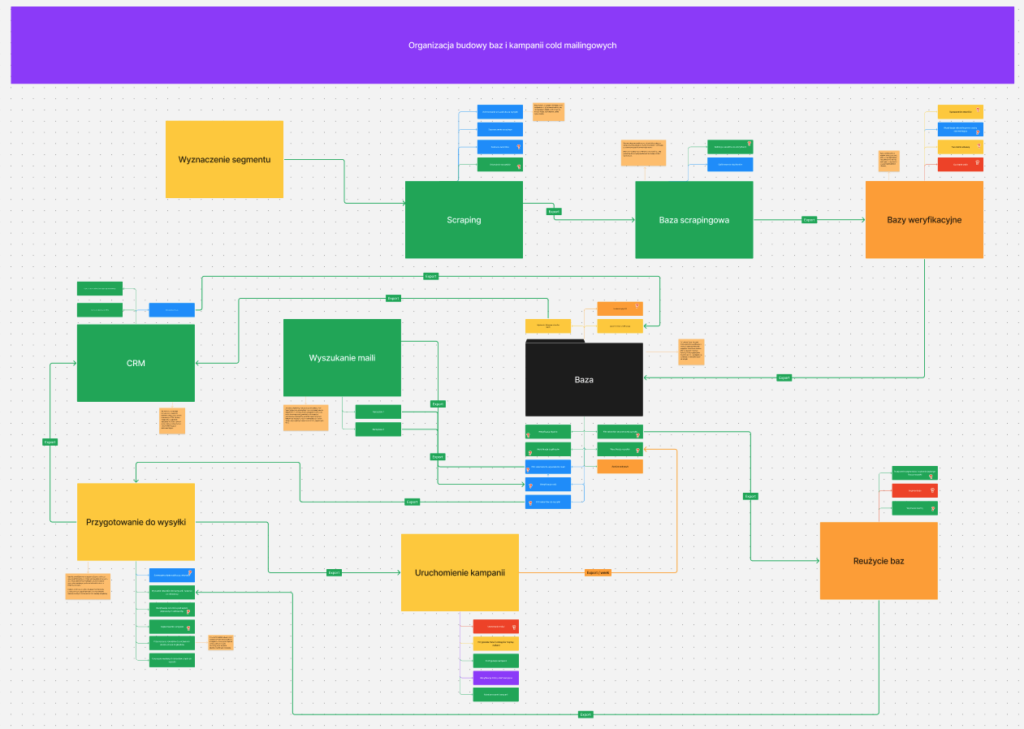
1. Careful preparation of the recipient database
To run effective prospecting, regardless of the chosen channel, you have to start by properly defining what the value proposition of your company is. Then assess which element of the value proposition you want to take to the market and carry out proper segmentation.
Build a segment of clients for whom the chosen element of the value proposition should be most appropriate. What does that mean? Roughly that ideally the problems your company solves should be as large and painful as possible for that specific segment.
When choosing a segment, keep in mind that it should be reachable, i.e. potential clients should be possible to locate and contact. Before you decide on a specific segment, do a little research and check whether you will find sources from which you will draw data.
How to build a good list?
To build a valuable database of potential clients within the chosen segment, you need to adopt transparent qualification criteria and keep on the list only companies that actually meet them. It is good to adopt both positive and negative qualification criteria.
The point is that practically only companies should remain on the list about which you have a conviction bordering on certainty that the value proposition you chose will fit perfectly. You must leave only those companies about which you know that they almost certainly struggle with the problems you help solve, and that they care about the kind of results you can provide.
There is one more important side effect: if you contact only clients whom you believe you can really help, and you do not go out with a vague, far-fetched promise, you will have greater inner conviction to actually carry out these activities. Such an attitude then has a big impact on the effectiveness of communication.
A specific person, not a company
Searching for companies is only the first element of the process. You will not be contacting a company, but a specific person in its structure. Depending on how you defined the decision model in the chosen segment, you must select a specific persona to whom you will direct the communication.
We do not send cold mailing to general company or department addresses, but to a specific person by name.
If you target owners or board members, you will find them in company registers (in Poland: KRS and CEIDG). If other people in the organization, for example managers, you can look them up on LinkedIn or in applications that offer such searches.
Once you have the company, its internet domain and a specific person by name, move on to enriching the database with specific email addresses, phone numbers and LinkedIn profiles.
Run the email addresses through one or two additional verification applications. If you send messages to non-existent addresses, you may have a bounce rate above 5%, and that will affect the deliverability of all your emails.
Final verification of the list
When you have the final database, carry out one more final verification. Check that the list does not include competitors, someone you know personally and do not want such communication to go to, or your current or former client. You also need to make sure not to send messages to people who have explicitly said they do not want them, especially when re-sending to an existing database.
It may be news to you, but larger companies that rely on outbound sales even have entire data mining departments dealing with building and qualifying databases of potential clients. In a smaller structure, when you have clearly defined qualification criteria, you can use external contractors who will perform such qualification. You will find them on popular freelancer platforms and you can pay them per record.
Outbound starts where marketing ends. In marketing we try to interest a broad group of recipients with our communication, so that among them there is a share of the clients we want to have. In outbound we have a specific client in the database: a client we want to take further into our sales process.
And if you are now thinking that this is a lot of work and effort, you are absolutely right.
2. A well-thought-out communication strategy
We need to create a sequence of messages and fill them with content. Not one message: a sequence. A single email can be missed in the inbox, even if it aroused interest. There is a good chance that something else at the same moment will grab the recipient’s attention. They will think they will come back to it later, and forget. Especially if what you are trying to attract their attention with is not currently their biggest priority.
That is why we create a sequence of several messages: to remind the recipient of ourselves and give ourselves a chance to interest them, coming from a different angle of attack. If what you wrote in the first message does not resonate, you have the opportunity to write something else in the next one. In this way you increase the overall chance of success.
What makes an email get opened?
Assuming the message reached the inbox, three elements influence whether it will be opened.
The sender. It should be a specific person by name. A From in the form of “Lukasz from TechMine” does not work; it immediately evokes associations with promotional communication and will be ignored in a fraction of a second. It is best if the From is a first and last name, the structure of the email address looks credible (containing the first and last name) and the address is in the company domain, not on free Gmail.
The subject line. Here the general rule is that the subject should in no way suggest or resemble anything we know from typical marketing or sales communication. It is not meant to be clickbait or straining for originality.
Ideally the subject contains at most two or three words and resembles the internal communication the recipient might receive. We do not use emojis or punctuation marks, we avoid words that raise the anti-spam score. The subject should not mislead; it must be adequate to the content of the message.
Once one of my clients, the CEO of a very large company, pondered what I had told him about subject lines and concluded: “So you are saying, Lukasz, that these days, to interest a potential client, you have to write them something boring?”
There is a lot of truth in that. We are all numbed by the flood of wonderfulness we receive in our mailboxes. Ordinary subjects, without straining and frenzy, have the greatest chance of standing out.
The beginning of the message. Most emails today are read on mobile devices, and even in email clients we usually have a preview of the first hundred or two hundred characters of content enabled. What you put at the beginning of the email will have a considerable impact on whether it gets opened.
Structure of the first message
Before I start creating content, I first develop something I call a segmentation table. It is a multi-variant table that maps the structure of the email and provides keyword input for its individual elements. It is based on the value table prepared earlier at the stage when the sales strategy.
The structure I am about to present is not the only or probably the best message structure, but over the years it has worked very well and still gives good results.
Here are its elements:
Direct address to the persona – something like “Mr. Smith” or “Hi Paul”, depending on what tone of communication you adopt and who your persona is. It is also a simple element of personalization: the recipient immediately sees that the email is addressed to them.
Reason for contact – a justification of why you are actually getting in touch, so that the recipient sees the point of continuing to read.
Situational context – for example an observation about the recipient’s industry. The reason for contact and the context can connect directly with the main problem. The task of these elements is to make the recipient start to believe that the communication concerns them, and to show that we know whom and in what context we are addressing. That this is not mass spraying of messages at random people.
Main problem – here we address the most painful problem or problems we suspect the recipient has. This is where it is checked whether the work done at the stage of choosing the segment and profiling the persona was done correctly. If we hit real problems, we have full attention. If not, there are many issues to work on again before the communication starts to resonate.
Consequences – preferably the negative ones the recipient should keep in mind if they do nothing to eliminate the problems mentioned. The point is for the awareness of the challenges they face to be as high and painful as possible.
Value proposition – and only now, when the effect has been triggered, is the only moment for a concise suggestion that a solution exists. One short paragraph, at most two or three sentences. It is only about placing your company in a specific area of solutions. Do not write at length: if the client has the problems you wrote about, you suggest that you may have a solution for them.
Call To Interest – I do not use a typical Call To Action in the form of a request for a meeting. Instead I ask about interest. Remember that this is the first contact with a person who most likely has no idea about you or your company. Asking for a meeting or even five minutes is too much to ask. People are reluctant to give even a minute of their time, because it is a non-renewable good.
It is also a mistake to send a Calendly link or ask them to read additional materials. A cold email serves only to open communication and build initial interest. It is not the place to offer anything.
A simple: “Would you like to learn more?” or “Does what I am writing about sound interesting?” is enough. To a question asked this way it is very easy for the client to answer “yes”, “please send information”, and sometimes someone writes “please send an offer” or even “yes, let’s set up a meeting”.
Signature – slimmed down as much as possible. No elaborate content or images. Preferably text-only, with a direct phone number; some people prefer to simply pick up the phone and call. In the signature you can slip in additional information about the company by adding to the name a slogan illustrating what you do. Make the company name an active link to the website; it should be the only active link in the message. Each additional one raises the anti-spam scores. Also avoid link shorteners.
PS (optional) – depending on the adopted level of personalization, you can include there a funny remark, an industry observation or a compliment to the recipient. A PS gives the message more naturalness.
Tone of communication
The whole message should be formulated in a presumptive, guessing tone. We do not insist that we know everything about the client’s company for certain. It is worth using phrases such as: “I often come across a situation in which…”, “when I talk to other managers, I hear that…”, “from my observations, sometimes in companies it happens that…”.
It is good to adopt a slightly withdrawn, inquiring attitude, rather than position yourself as someone who already knows everything. Then even if you are wrong about something, there is a chance the recipient will politely correct you, and thereby open communication.
Subsequent messages in the sequence
In subsequent messages you can address other groups of problems you suspect the client has. We do this, however, in a different structure than the first message, maintaining consistency and continuing the narrative, even if the client does not react.
Most often I create sequences containing 4 to 5 messages, sent at intervals of 3 to 5 working days. Generally I would not exceed two messages a week.
Do not focus on the length of the sequence, but on its accuracy. If you have a well-worked-out segment, two or three angles of attack should be enough. Either your communication will resonate or it will not, and then you have to go back to the communication strategy and do another iteration.
Increasing the number of messages that are inadequate to the recipient’s situation can only lead to their frustration. It is not about the quantity, but about the quality of the communication conducted with a single lead. All communication, however, has to be conducted at the right scale to give yourself a statistical chance of success.
For most small companies I suggest initially aiming for output at the level of 400 to 600 individual sequences per month. Such a sample allows you to verify the communication and gives a statistical chance of results.
3. Technical aspects of sending
Doing solid substantive work will be of no use if the messages land in spam. There is a number of technical measures that have to be carried out to prevent this.
Domain
Ideally you use a domain that already has some credibility and was not bought a week ago. It should be directly linked to your company and website; we do not want to mislead anyone.
Some claim that the main company domain should not be used for cold mailing. Given the scale of the activities we run and the number of messages that go out into the world, I have been using the main domain for years and my clients do the same. Nobody has ended up on any blacklist yet, because the number of messages we send has nothing to do with the sending levels of companies spamming en masse. If, however, you prefer to err on the side of caution, you can use an auxiliary domain.
The domain has to be properly configured: take care of SPF and DMARC records (you will find tutorials online).
Mailboxes
Sending must be done from physical, separate email accounts. Aliases cannot be used. Sending cold mailing is something different from typical marketing mailing.
Prepare several mailboxes right away, because message volumes from one account cannot be too large. Providers of cold mailing tools suggest not sending more than 200 to 300 messages from one account per day. From my experience, and with far-reaching caution so as not to fall into spam and onto blacklists, I suggest not exceeding 40 messages a day from one mailbox.
As is easy to calculate, if you aim for about 500 sequences a month, you will need 3 to 4 mailboxes in rotation, depending on the length of the sequence.
I use mailboxes both from Google and from the hosting provider. You have to pay extra for each account in Google, but to begin with I suggest starting precisely with it, because cold mailing tools do not always want to cooperate with other hosting providers.
The downside of shared hosting is the shared IP you use: even if your activities are fine, someone else can cause your sending IP to end up on a blacklist. If you want full control over this, you can think about a dedicated IP at the hosting provider or setting up your own mail servers.
Warming up mailboxes
Once you have added the mailboxes to the cold mailing tool, they need to be warmed up. Warming up consists in gradually accustoming mail servers to a certain volume of messages sent from a given mailbox.
The point is to simulate the activity of a living person. Tool providers suggest that warming up should last at least two to three months. From my experience, if the domain is fine, two to three weeks are enough. If after that time the inbox delivery rate is at the level of 99 to 100%, we can start sending.
Warmup happens automatically. It is worth checking how the messages are treated by different mail providers. It happens that one of them particularly dislikes us; then the warmup can be directed with greater intensity at that provider, so that its blocking algorithms “like” us after all.
The effectiveness of cold mailing in numbers
I am far from giving a single number, because the final result is made up of many issues: from the chosen segment, through defining value, to communication. I can, however, share observations.
When I listen to fellow consultants from across the ocean, they claim that among their clients the open rate oscillates around 20 to 30%. Among my clients who follow the process I discuss here, the open rate oscillates around 60 to 80%. If it drops below 50%, I sound the alarm and we modify the activities.
The level of clicks on links in messages? From my experience it ranges from 10 to even 35%. This is important information, because if you redirect the recipient to your website, you can catch them in remarketing and engage them in communication in other channels as well.
As for the reply rate, across the ocean they say the rate is below one percent. With me, depending on the segment, it is from 2 to even 8 percent. I am talking, however, about segments and sequences already tested, because at the building stage it happens that for a few hundred messages there are no replies at all. Then you have to iterate until it works.
In the other direction, if we aim well, there are sequences in which sending messages to just a few dozen recipients can translate into several or even a dozen meetings.
I must admit that these numbers keep falling. The algorithms of mail providers work more and more effectively, and practically month by month I observe falling conversion levels in cold mailing campaigns.
For the numbers to keep adding up, additional measures have to be taken. You can randomize the content of messages without changing the core of the message, use many accounts and domains in parallel, send messages at scale but so that they differ for each individual recipient. Many other techniques and measures increasing effectiveness can be applied as well.
Case study
Recently a client of mine, whom I asked to send only a small test batch because she had not yet built a larger database, wrote to me:
“Hi Lukasz, I think the statistics are not bad 🙂 Out of 11 emails sent, two people replied. One passed it on to the right person, and the other is asking about our experience. I am very happy 🙂 Have a good day”
After some time I can say that both of those companies became her clients. Out of 11 emails sent, two new clients. Such is the power of a well-prepared process.
Summary
There are three main areas you need to focus on to give cold mailing a chance to achieve good results.
The first is a very well prepared, qualified and enriched list of message recipients. We contact only companies that may really need our help.
The second is well-thought-out and adequate communication that is about the client, not about your company.
The third is taking care of the technical issues, to give recipients a chance to get acquainted with our communication and not fall into spam.
I have discussed here the main issues that need to be taken care of to do cold mailing reasonably correctly. As you can easily guess, there is still a number of nuances that will decide the final effectiveness. It is not about the number of messages sent, but about their quality and accuracy. A good cold mailing campaign is one that resonates with the recipient, because it responds to their real problems and needs.
I discuss this topic much more extensively in episode #23 of my podcast “Droga Przedsiebiorcy” (The Entrepreneur’s Road, in Polish): “Cold mailing: how to do it well?”. You will find the podcast on all leading platforms.